Guest Blog by K.B. Morgan

K. B. (Kitty) Morgan is a friend of a friend. Love this story and thought you would enjoy it, too.

fansshare.com

How We Came to Love Rottweilers

Most people dream of traveling when they retire. Having done so much of that during our careers, my partner and I dreamed instead of having dogs in our lives again.

Our original retirement destination was 4 acres of beautiful, off-the-grid wilderness on the NE corner of the Dominican Republic. We’d never built a house before but, in preparation for our big move, we asked around and were told by just about every expat living there that what the locals feared and respected most were large dogs with black faces and pointed ears. I wanted a short flat coat for wash and wear grooming and to see ticks quickly. We turned every page of the big 700 Dog Breeds book and discovered there is but a single breed that meets all four requirements:  Dobermans. We were mentally sold and started collecting books specifically on that breed.

Time marched on and while visiting the D.R. one summer, we met an expat who bought a small café in town and an enormous 14-acre finca near our property.  We were enjoying cocktails with him one evening and discussing dogs when Gerry made the odd comment, "Nah, nah, nah. You don't want Dobermans because a Doberman won't let anyone in...but a Rottweiler won't let anyone out."  This didn't make much sense to us until we visited the fina a few days later. A large red and white sign on the gate translated: “Caution, Bad Dogs.”  (Years later, our Mexican neighbors had a similar sign on their front wall that read “Caution, Killer Dogs” which turned out to be nine female Chihuahuas and their father, Romeo.)  

Gerry wasn't at home when we arrived but his caretaker Pindo let us onto the property. There was a small house near the front gate and a long garden shed on the other side of the driveway, open on one side, where five enormous Rottweilers were snoozing but quite alert. They were totally disinterested in us two trespassers for the hour or so that we strolled the property until we returned to the house to leave. Very slowly they rose; very slowly they approached me, surrounded me, leaned into me and did that huffy drooling thing that excited Rotties do. They expressed more and more interest as I tried inching my way to the gate. I was terrified and froze in the driveway – so close and yet so far from escape.

“Please,” I asked my partner, “go find Pindo, tell him we’d like to leave but we’re afraid of Thor, Zeus and the three girls.”

Eventually, Pindo returned and put the dogs inside the shed as if they were Yorkies.   The minute I was on the other side of the gate, my legs gave out and I crumpled to the pavement. I was shaking so hard I couldn't stand. My partner and I looked at each other and decided then and there that Rottweilers were probably too much dog for us. We were back to Dobermans, such elegant quick creatures, unlike the lumbering, slobbering Rottie.

Several weeks later, we spent a very pleasant afternoon at the finca picnicking on the grass with Gerry, Thor and Zeus. When we asked Gerry where the three girls were, he told us he had to re-home them because they were constantly raiding his neighbors’ properties, bringing home entire pigs and cows for dinner for which his neighbors were demanding payment.

Fast forward and we ended up in Mexico’s Yucatan.  We spent our first two years finding a house and making it habitable before we were finally ready to bring home our dogs!!!  We had seen two very large Dobermans in the local nursery while buying plants and asked the nurseryman where he got those beauties.

“Oh, those were untrainable,” he told us. “I sold them because they were too high strung, had too much energy and were into everything.”   (In my opinion, they were obviously bored with so little to do except watch the plants grow).  

We were mightily disappointed until he added, “But I have Rottweilers now and my bitch just delivered her first litter. Come see the puppies, all thirteen of them!”  We saw this as an omen.

We fought the urge as long as we could, but eventually succumbed and brought Bruno home, the best ambassador the breed could ever have. He was the sweetest, most mellow, loving creature yet, even a playful slap from a friend in my direction would have him up, his huge maw very gently around the offending wrist. Don't mess with my mommy!

Rotweilersonline.com
I only had one dog as a child, a sweet mutt who lived to the ripe old age of 24 so I wasn't accustomed to having dogs until Bruno taught me what I needed with infinite patience. He was my best friend for 7 short years. He crossed the Rainbow Bridge in 2008 and I miss him terribly to this day.
Bruno made us Rottie fans and, in retrospect, they actually turned out to be the best breed for us because we're older now and they're not quite as energetic as Dobies. I know this from personal experience as our Willie is a “Doberweiler“  (or “Rottenman,”  if you prefer). He turned ten last November and still has plenty of energy. Daily playtime with him wears us out but, I confess, he's my favorite of our five adult dogs because of his huge personality and goof ball antics.
After Bruno came Ivan, pure joy in a fuzzy, black-and-tan package, followed by Chester (a/k/a Grumpy as he was a soloist and never a pack member) and silly Willie, our Rottie-Dobie mix. They’re all in Dog Heaven now except Willie who’s on borrowed time. Knowing this, last month we brought home the next generation:  ten-week old brothers Ozzy and Gus. They will likely be our last dogs and we hope they don’t outlive us as the market for re-homing adult Rotties is slim to none. (Although we have provided doggie godparents for them in our wills).
It has been a wild and wonderful Rottie ride and I have never regretted choosing the breed; they’re smart, playful, loyal and extremely protective of their homes and their people.


adogbreeds.com

 The Rottweiler is a large size breed of domestic dog. The dogs were known as "Rottweil butchers' dogs" because they were used to herd livestock and pull carts laden with butchered meat and other products to market. 


THANK YOU, Mr. Richard Bloom, D-Santa Monica,

Article image
Nationofchange.org
The movie, BLACKFISH, leads lawmaker to introduce bill.

YOU CAN HELP! 

ASHLEY CURTIN
NationofChange / News Report
Published: Saturday 8 March 2014
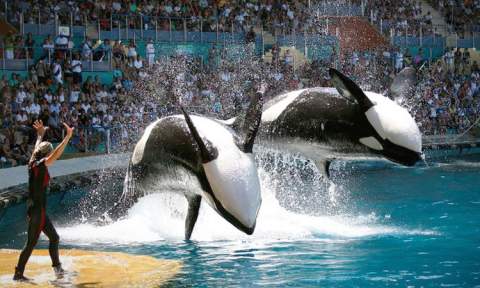
The proposed bill, (introduced by State assemblyman Richard Bloom, D-Santa Monica,) would make it illegal to “hold in captivity, or use, a wild-caught” or “captive-bred orca for performance or entertainment purposes.” 

"Currently, SeaWorld in San Diego is the only facility in California that has 10 orcas held in tanks for entertainment purposes and, if the bill were signed into law, the facility will be forced to make changes.

While many other aquariums around the world are proven to be just as successful without showcasing captive orcas, California might just be on pace to join India, Croatia, Hungary, Chile and Costa Rica in outlawing cetacean captivity altogether."


Legislation would make it illegal to breed, import, export or keep killer whales for entertainment purposes in California
Legislation proposed by a Santa Monica assemblyman could prohibit SeaWorld from keeping performing orcas at its San Diego park. (Bob Couey / Associated Press / January 20, 2003)
http://www.latimes.com/entertainment/movies/moviesnow/la-et-mn-blackfish-legislation-seaworld-killer-whale-20140307,0,964326.story#ixzz2vURV2RcY

Dogs in touch with our Feelings

 I'm down with the flu, but a friend sent this. It made me feel better.


 From Science Now

Sit. Stay. Scan. Dogs' brain scans reveal vocal areas similar to those in human brains.
Borbala Ferenczy
Sit. Stay. Scan. Dogs' brain scans reveal vocal areas similar to those in human brains. 

"...other research has shown that dogs “respond to the way we say something rather than to what we say.” The similarity in auditory processing, he adds, “helps explain why vocal communication between the two species is so successful.”

Guest Blog: Snow Monkeys by Yoko Kobayashi

Catching up on sleep
A little heaven in Jigokudani (literally, the valley of hell) in Nagano Prefecture, where the Japanese macaques known as Snow Monkeys  for their amazing life in the cold northern most habitat. They are daily visitors to the Jigokudani Yaen Koen (Jigokudani Wild Monkey Park) managed by a private railway company and their knowledgeable staff, including the National Geographic's Nature's Best Grand Prize winning photographer.  


These Snow monkeys are the only known group of monkeys that bathe in hot springs: Inside the Park, there is a hot spring bath reserved exclusively for them and we can see families take warmth from it while grooming each other. They sleep in trees in the woods to avoid their predators, each night at a different location, and sleep is always so precious to them. In a safe environment inside the Park, they relax in the hot bath and doze off catching up on their sleep particularly on snowy cold winter nights when the cold disturbs their sleep. 


Nagano was once a location of the Winter Olympics, and is where winter lasts nearly six months from October to April.  The park is open all year round and is located at the foot of Shiga Kogen Heights surrounded by many well-known hot spring resorts like Yudanaka, Shibu and Kanbayashi.  


All photographs were taken by Yoko Kobayashi 


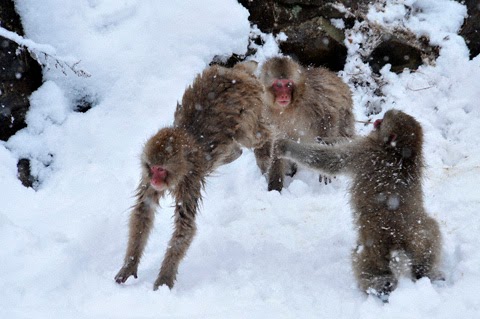
 February: Young monkeys

 playing in the snow.  


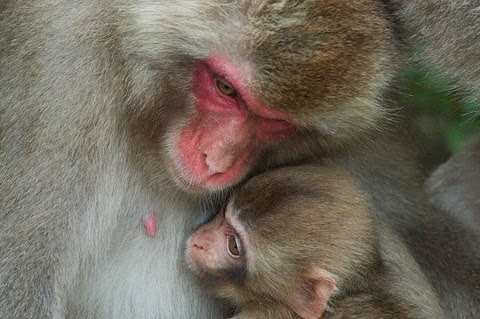
At the end of September, babies born in spring are about 4 to 5 months old and mothers care for them 24 hours with utmost care. 

It is cold in December:  This veteran mother is warming herself in the hot spring while her nearly two year old child in winter coat sits on her back avoiding getting wet. 

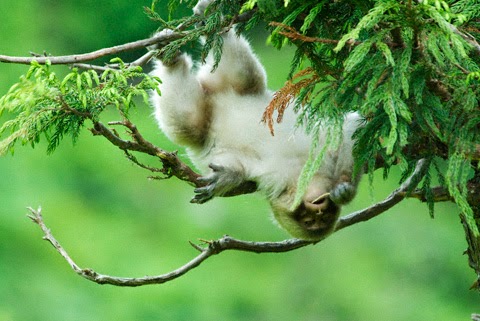
June, during the rainy season in Japan, 
baby macaques nibble on cedar leaves while playing with her peers.  


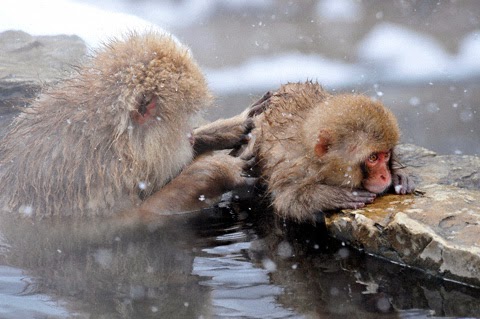
In March, temperature starts going up a bit: A baby being groomed by his Mom. 
In June, this newborn baby is barely two months old:  Newborns start exploring their surroundings but always by their mothers' side.  


Will it never end??

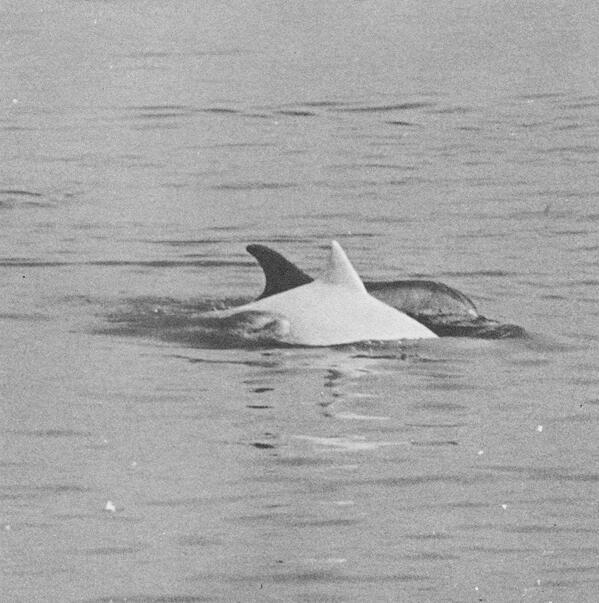
Pictures and entire storyThis is a picture of Carolina Snowball in 1962. She was captured for the Miami Seaquarium in August of that year off the coast of South Carolina, which subsequently became the first state to ban the capture of marine mammals in their waters.

Carolina Snowball was a huge hit at the Seaquarium until she died in 1965, but they still saw an opportunity to make a buck off her, so they stuffed her and hung her body from the ceiling, and put one of those make-a-mold machines beneath her. When I was researching Dolphin Sky in 1985, she was still hanging there. When I went this year (again for research, which is the only reason I would spend a nickel at the marine mammal hell-hole,) Carolina Snowball's body was gone. I looked online and found the entire story of her capture with amazing photos of that event and her short life at the Seaquarium.
Carolina Snowball, the entire story


Flash forward 52 years to Taiji, Japan's annual round-up and slaughter of dolphins. (See the movie The Cove if you've just arrived from some other planet.) They captured this white dolphin calf. Story below. I don't know what else to say.
albinodolphin
Albino Dolphin calf


Taiji slaughter

Still in the land of the Living

It's been a couple of weeks since my last post. The time has been spent trying to finish the novel I'm working on and get is sent off to NY. I'm close. 

A friend sent  this video. I'm always reminded of how much we credit ourselves with superior intelligence and discount the intelligence of "lesser" creatures. Try to imagine a crow's brain a hairless ape. You'll get what I mean after you watch the video.
onlyhdwallpapers.com

Incredible Crows
Incredible crows

In the Eye of the Beholder


This might look like the morning after a hard night, but it's really one lucky kitten that has taken to its people and its new home with cat-like aplomb.

I wish you all this kind of peace & comfort, health & happiness in the new year. And if you are confronted with a challenge may your friends and family provide the comfort and support you need to make through. 


The Power of Belligerent Thinking

Lolita begging for food
My friend, Norma, sent me this article from the Miami Herald.                                  

Seaquarium for Sale?

In it it says that the activists' lawsuit against Seaquarium had been dismissed. The next day they printed a correction: The lawsuit against Seaquarium has NOT been dismissed by a judge and is ongoing.

Just so you don't miss the line where Arthur Hertz, the owner of the Miami Seaquarium, thumbs his nose at the decades-long struggle to free Lolita, a wild-caught Orca, the Herald quotes him as saying, "the activists’ objections 'are still going on,' but their demands that visitors boycott the Seaquarium has had no effect. 'The public doesn’t care.'"

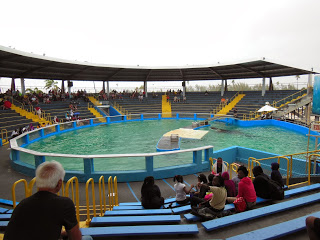
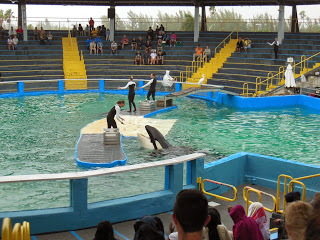
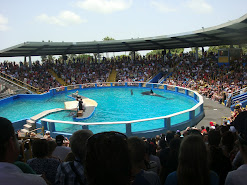
I took these pictures that day. As you can see, there's not much of an audience even though it included two school buses full of middle school kids. What did this experience teach them? Animal abuse, as long as people enjoy watching and are willing to pay for the privilege, is okay? Imagine what they would have learned if our inhumanity hadn't been on full display.
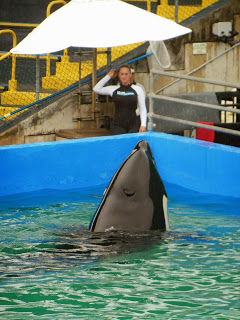
Lolita's tank for 42 years. It measures 80 X 35 and is a foot deeper than she is long.


Her total focus is food, and she does what she has to do for a reward.


Video
we just need more of them 

It's Me, Me, Me.

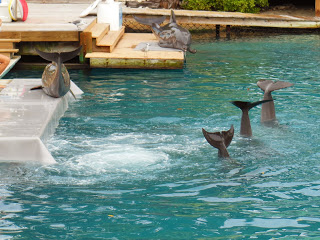
Dolphin Show at Miami Seaquarium
As a writer, I get asked all the time what I'm working on. Some writers are reticent to answer. They think it robs the creative energy, or that someone is going to steal their idea. I never worry about either of those things. My creative energy is always in flux, tidal in fact. If it's really low, I find myself totally engrossed in thoughts of the next book, the one on the stove top in the back of my brain. As for anyone stealing the idea--POO. Ideas are a dime or less a dozen. If the idea-thief sat down and started writing today, what that person would produce would be nothing like your story. You can't steal a writer's voice or his/her perspective on a story. Besides, I have a contract and a hundred and fifty page head-start. :-))

When I was in Orlando a couple weeks ago for the Sunshine State Young Readers award, I happily answered that I was working on a story about an autistic child and a dolphin. One hears a lot of apcray (remember your pig latin?) about Dolphin Assisted Therapy (DAT) and the wonders it works for children with disabilities. I can't say that it doesn't help, but it is not a path to a cure for anything. I do believe in therapy with horses (as you might already know.) The difference is dolphins are not meant to be imprisoned in chlorinated, saltwater tanks. They are not meant to be corralled and fed dead fish so that a child with autism can clutch a dorsal fin and go for a ride around their pen. They are one of the most intelligent creatures on the planet, and in most cases, far more humane than we are.

All that aside, when I talk about a new book, people want to help. You never know who is going to know someone, or something, that will turn out to be just what you needed. One of the leads I got was about a program in Marco Island, Florida. I sent an email to Capt. Chris Desmond at Dolphin Project and WOW! They have been doing Coastal bottlenose dolphin surveys for years, and have a program that takes the public out to help--especially children. Kind of a mini-Earthwatch. Capt. Chris was immediately on board (excuse the pun) with my project, and has already been a huge help.


Here's my cool award: beautiful glass.bookends that came in a box with a pair of white gloves. My acceptance speech is below.

And then there's this letter from 14 year old, Lauren, of Medford, NJ,. Letters like this are very close to reward enough.

Hello Miss Ginny Rorby,

My name is Lauren, sign name L touched to the right corner of the lips (my deaf friend made the observation that I smiled a lot the first time we signed together). I'm not e-mailing with any book club, or with the intent to arrange a phone-meeting, rather, I just wanted to share a few thoughts with you. I've just finished reading your book "Hurt Go Happy" for the fifth time, and I enjoyed it just as much as the first few times I read it. I wanted to let you know how much I admire your work, and your dedication. Not only that, but your book really kick-started my drive to learn American Sign Language. Being a young teenager, I sway from hobbies a lot. But I always come back to ASL. I don't know a lot, but I'm working on it. I've decided that I want to enter a career field that involves, in some way, sign language and the deaf. I'm looking into teaching in a school for the deaf, or maybe even becoming an interpreter. Now I don't mean to ramble on, I just wanted to share with you the impact that you've made on the way I view many things, and on where I plan to go in my future. Your book has truly touched me, and I thank you from the bottom of my heart for sharing with the world this wonderful piece. Thank you.


 SSYRA Acceptance speech

No one could be more surprised or happy to be here than I am.  
I was adopted and grew up in a home with an alcoholic father and a mother trying to control his drinking. I have an amblyopic eye, so between my eyesight and a chaotic home life, I did poorly in school, graduating from Winter Park High School with a C- average and I never got higher than a D in English. 
            However, I hated feeling like a dolt, so I enrolled at the University of Miami when I was 33. I took PSY 101 & detective fiction.  Animals were my single passion so the next semester I took a biology class. When I was 38, I wrote and editorial about an abandoned dog. After it was published, I enrolled in a creative writing class.  
My first short story was about my husband sinking his airboat and having to walk out of the Everglades. I rewrote it for every subsequent class because I couldn’t think of anything else to write. I didn’t really believe I could write, must less that I wanted to. 
I graduated from college with I was 41, with straight As, and finished graduate school when I was 47. My first novel sold when I was 50; at 60, my second book—Hurt Go Happy was published. I’ll be 70 when my 5th is published in the summer of 2015.
I hope I’m an inspiration to young and old alike. To poor students and those with cruddy home lives. I hope I’m an example of the value of an education no matter how long it takes you.  And I hope I’m an encouragement to adults that it’s never too late to start again. I think those of us who create rich lives for ourselves have honed an optimistic spirit & a refusal to listen to the naysayers—especially our own. 
I was asked once how long it took me to write Hurt Go Happy? When I said 18 years, the little girl said, “Oh, that’s too bad, I was hoping to read your next book.” I’m afraid to tell kids that I noodled Lost in the River of Grass for 31 years.
I can’t tell you how honored I am to have IT win this award in my home state—in my home town.  


Taking a Break.

 I'm going to take a couple weeks off to work on my new book--maybe even finish the first draft.

Here's a cute video. Thank you, Carol


It occurred to me that having a bag catnip with you on a walk in the woods might be just the thing to toss to the next mountain lion you meet on the trail. Or not. It might draw them in from miles around.

 A friend sent this to me this morning. (Thanks, Mary Elizabeth.) I wish I'd seen this article before traveling from Montana to California with Sully, the Ring-billed gull (See last month's posts). But it's more than just information about pet-friendly hotels, campgrounds, restaurants, beaches, and dog parks, it also gives other information about the valuable of pets in the lives of their human companions.  


"Humans rescue animals, but animals show up for a reason—most humans can use some rescuing, as well."
usvetsadoptpets.org

What's Right for Whales?


Lolita at Seaquarium
Photo by NG
Photo
Lolita's tank for 37 years.
Photo by NG

*I don't know why this is double-spaced and couldn't fix it.


I've got great news and bad news. I've been asked by a rather famous publishing company to write (another book) about a dolphin and an autistic child. This is a first for me. Usually, I struggle to come up with an idea, struggle (often for years) to write it, then enjoy numerous rejection letters before finding a publisher, or giving up and putting it on a shelf in the closet with my other failures. To be honest, I hardly know how to act under these circumstances. 


I've been working on this book since April and am getting there. The bad news is I have to visit the Miami Seaquarium to finish up my research.

A portion of Dolphin Sky took place at the Seaquarium. It was a cruddy little place back then. Hugo, the Killer whale, was the star attraction, as was one of the Flippers. Hugo died, so they replaced him with Lolita. (There's a movie about her capture entitled, Lolita.)


A few nights ago CNN showed the new documentary Blackfish, about the Orca that killed his trainer at Sea World in Orlando. I'm begging you to see this movie. 

BLACKFISH is available on Netflix after 11/12/13.     


By Elizabeth Batt
Jun 27, 2013 in Environment

Miami - Time is running out for a solitary orca held at Miami Seaquarium. Lolita, also called Tokitae, was one of the first whales in a brutal roundup that captured orcas for display in marine parks between 1965 and 1973.

Lolita is the last surviving orca of about 45 members of the Southern Resident community who underwent a brutal capture that saw several other orcas perish in the attempt. For more than 40 years, she has resided in a 35-foot tank (many say illegally-sized), at Miami Seaquarium in Florida. Lolita has not seen another orca in more than 30 years. Her once companion orca, Hugo, died after repeatedly hitting his head against the tank walls. Yet in the wild, her mother still lives writes Candace Calloway Whiting at Seattle Pi:
  

And then, a little more good news:


‘Astonishing’ North Pacific right whale sighting is only the second in 62 years off British Columbia

North Pacific right whale spotted last week off British Columbia. Photo by John Ford
Right Whale

Last previous sighting was a mammal killed by whalers in 1951; it's the most endangered whale species on earth 

Full Story Pacific Right Whale sighting


Drawing of a North Pacific right whale is courtesy of Wikipedia, via NOAA

Why are they called RIGHT WHALES? 
Because of their docile nature, their slow surface-skimming feeding behaviors, their tendencies to stay close to the coast, and their high blubber content (which makes them float when they are killed, and which produced high yields of whale oil), right whales were a preferred target for whalers. Today, the North Atlantic and North Pacific right whales are among the most endangered whales in the world. Wikipedia.

Dogs dying, "FDA clueless"

 UPDATE:

Jerky Treats Recall: FDA Issues Alerts After 600 Dogs And Cats Mysteriously Dead, Full List Of Pet Treat Recalls

on October 23 2013 12:16 PM
If your dog or cat has gotten sick after eating jerky treats, the U.S. Food and Drug Administration needs to hear your story. While a formal recall has yet to be issued, the FDA is aware of thousands of pet illnesses and deaths tied to jerky treats made in China, and it's asking vets and pet owners to help find the cause.

On Tuesday, the FDA issued a warning -- not a recall -- about alerts it has received over several years concerning Chinese-made jerky treats in tenders or strips made of chicken, duck, sweet potatoes and/or dried fruit. Since 2007, 3,600 dogs and 10 cats in the U.S. have fallen ill after eating jerky. Of these pets, 580 died. (This number is now 600) (gr)

After six years of research, the FDA is still clueless as to what is causing this long outbreak.

"This is one of the most elusive and mysterious outbreaks we've encountered," FDA Center for Veterinary Medicine Director Bernadette Dunham, DVM, Ph.D, said. "Our beloved four-legged companions deserve our best effort, and we are giving it."

The CVM said it has conducted more than 1,200 tests and visited jerky pet-treat manufacturers in China but cannot determine the cause of illness. The biggest problem is that many of the treats were made in China, where manufacturers of pet foods and treats are “not required by U.S. law to state the country of origin for each ingredient in their products.”

As such, the FDA is asking pet owners and veterinarians for help to find the elusive cause. A fact sheet is available for vets to know the exact lab tests needed in order to help as well as how consumers can help report illnesses or deaths.

"Our fervent hope as animal lovers is that we will soon find the cause of—and put a stop to—these illnesses,” Dunham said.

The FDA said the treats in tenders or strips made of chicken, duck, sweet potatoes and/or dried fruit have caused illnesses within hours of consumption. The treats have caused symptoms including decreased appetite, decreased activity, vomiting, diarrhea (sometimes with blood or mucus), increased water consumption, and/or increased urination. The fatal cases have come from kidney failure, gastrointestinal bleeding, and a rare kidney disorder.

The agency said pet owners should be cautious or completely stop feeding their dogs and cats jerky treats. The FDA also recommends seeing a veterinarian if a pet becomes sick after eating jerky treats and asks owners to save the remaining treats and packaging to help solve the mystery.

Short of a formal recall, the FDA said it removed some jerky treats from store shelves in New York in January after a lab found “evidence of up to six drugs in certain jerky pet treats made in China.” Almost a year ago, some companies issued recalls for their products, according to The Examiner, including:

Nestle Purina PetCare Co.:
Waggin’ Train
Canyon Creek Ranch brand dog treats

Del Monte Corp.:
Milo’s Kitchen Chicken Jerky
Chicken Grillers home-style dog treats

Publix Stores:
Chicken Tenders Dog Chew Treats

IMS Pet Industries Inc.:
Cadet Brand Chicken Jerky Treats sold in the U.S.


  Here's the Huffington Post story

ALWAYS READ THE LABELS ON THE FOODS YOU BUY--NO MATTER WHAT THE FRONT OF THE BOX OR PACKAGE SAYS, TURN IT OVER AND READ THE BACK---CAREFULLY!


My Touretts is Back

Dolphin burgers for park visitors

WHEN it comes to walking both sides of a macabre street, it's hard to imagine a more audacious example than that of the Japanese town of Taiji.

Already infamous for the annual slaughter of dolphins that was brought to light in the documentary The Cove, Taiji has now announced plans for a marine mammal park.
Visitors can see dolphins and whales in a fenced-off section of a local bay. They can kayak and even swim with them and then snack on a dolphin burger from those slaughtered nearby.

In a project that has won the backing of figures from Japan's Institute of Cetacean Research - the overseer of the country's Antarctic whaling program - Taiji wants to partition more than 28ha of the local Moriura Bay for the park.

"The planned site faces the state road, and I think it will give a great visual effect if the tourists can see the whales swimming in the bay," Taiji town official Masaki Wada told The Australian.
He said black whales and bottlenose dolphins captured off Taiji - some of which are sold to aquariums each year - would be released into the area, creating a whale amusement park. But Mr Wada made it clear that the controversial and bloody dolphin slaughter in nearby Hatakejiri Bay - carried out by stabbing the mammals with sharp stakes - would continue as usual.

"Both of the concepts can coexist," he said.

"The town of Taiji is close to the Pacific Ocean and we can harvest various types of fruits of the sea including whales. We would like to display our cuisine culture.

"Now we have Kujira Katsu Burger (whale cutlet burger) sold at our swimming beach and it sells well.

"Of course there are some people who do not eat it, but it's about individual freedom.

"Our town will proceed with the concept that there is food culture, as well as tourism, when it comes to whales.

"We are not doing anything wrong, and we do not aim to cease our legitimate business because of criticism from outside."

The Cove, released in 2009, brought Taiji, 500km southwest of Tokyo, to worldwide attention, winning an Oscar the following year, after graphically showing the killing of the dolphins, thanks in part to hidden underwater cameras.

Activists continue to visit the town to protest the hunt and have already signalled (sic) they will oppose the marine park plan.

Taiji fishermen, and many Japanese across the country, are surprised by the strength of foreign criticism of whaling, arguing there is no distinction between the practice and that of killing and eating other species.

THE GOOD NEWS 
Training dolphins for people’s entertainment is no longer a tourist attraction in India. The country will instead close the many dolphin parks built across the country and ban any other commercial entertainment, which captures and confines orcas and bottlenose dolphins.

Schlepping Sully, the End

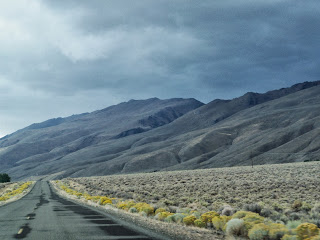
Through rain and sleet. . . kidding. Actually, as much as I'm not fond of a high desert landscape, the rain and the black clouds made it kind of beautiful. Sully and I dipped into Nevada, then back up into Oregon. As we neared the California state line, a single thought occupied my mind: will the fruit and veggie border patrol let me bring a gull into the State. I was hopeful. I brought my parrot in 22 years ago. I needn't have worried. They are still only looking for produce.

That day we made it to Burney Falls. I found a motel easily enough, but the less expensive queen rooms did not have tubs. For $20 extra, I could get the last king, and did I have a pet?

I was getting better at lying. "A bird, but he can stay in the car."

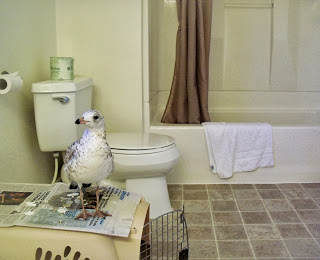
Though the motel looked like something out of the 1940s, it had the best bathroom of the trip. (As you can see.) I let Sully out and he flapped his wings, lifting off the tile floor, like a dancer. While I filled his bath, he bounced around the room, tapping the floor with his webbed-feet, and flapping his wings to lift himself inches off the ground--a ballet of sorts.

This was our third night in a motel, and Sully knew the drill. He flew over landed on the towel on the side of the tub and dove in. I had to close the curtain to keep him from flinging the contents of the tub out on the floor.   

The remaining fish was looking a little gummy, so I left him to enjoy his bath, and drove to Safeway, where I found two Tilapia fillets for four dollars.

The next morning, my tire pressure light was on. (And of course the Maintenance Required light still burned brightly.) I passed Mike's Automotive Repair on the edge of town, did a U-turn, and pulled in to have them check the oil and add air to the tires.

I think the worst part of the drive for Sully, and for me, was listening to him being pitched from side to side in the cage for the entire the length of Hwy. 20--the last leg of our journey.. (For unfamiliar readers, Hwy. 20 from Willits to Fort Bragg, is 33 miles of unrelenting twists and turns.) (Our roads, from inland to the Coast, are what keep us from looking like Disneyland in the summer.)

Sully and I had driven 1600 miles and I still hadn't decided what I was going to do with him. I'd whittled the choices down to Noyo Harbor, where the gulls trail after the incoming fishing boats, or Lake Cleone, which is north of town. It's a fresh water lake, and since Sully had been born on a freshwater lake, I was leaning toward it. At that moment, I was too tired to decide anything. It was 3 p.m.; I drove home.

There is an 8 X 8 foot flight cage in my backyard from my animal rehab days. I let Sully bathe in my tub, then took him out and put him in the flight cage. I decided to decide in the morning. 

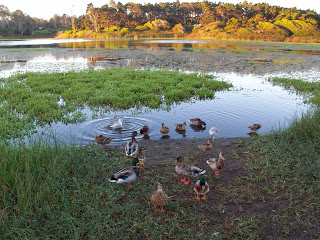
Sully was not used to flying, so I wasn't sure how strong a flier he was. He was also used to being fed by humans, and foraging for himself on the ground. Noyo Harbor was ideal for gulls used to following boats, and diving for fish scraps on the wing. That was not Sully. I thought the competition in the harbor would overwhelm him, so before dawn the next morning, I got up, stuffed Sully in his cage and drove to Lake Cleone. No more thinking about it, or weighing my options. I opened the cage door, and dumped him out. He ran straight through the crowd of ducks, launched himself into the lake and took a bath. That's Sully in the picture below, one minute into his new life.

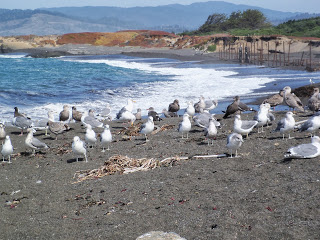
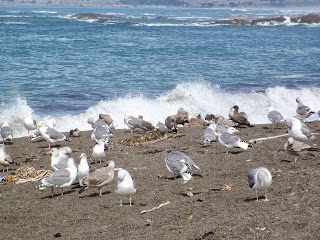
The other advantage to Lake Cleone is it's full of minnows, and insects, and just on the other side of an old road, is the ocean. There are hundreds of gulls over there, and they come to Cleone to bathe. My hope was he'd join them. Until he did, I would drive out every day to feed him.
Lake Cleone at sunrise

My heart nearly broke the next day when I went out with fresh fish and a scrambled egg and couldn't find him. 

The day after that, he was sitting on the grass with the ducks. He saw me wave to him through the windshield, blinked like he couldn't believe his eyes and ran to meet me. Fending off a young herring gull, I fed him a bowl of fish and an egg. He headed straight to the lake for a bath. 

For the next two days, he wasn't there when I was, then, last Thursday, I think I saw him for the last time. There are other 1st winter Ring-bills out there, but once the boo-boo on Sully's bill healed, I couldn't tell him from the others. I think it was him. He was near the picnic table, and he took what I tossed him, but he didn't come any nearer than the other three gulls. 
 
Lagoon Point looking west.


It's what I hoped for, of course, but I also miss him. I keep telling myself that I did all I possibly could. That's the hardest thing, isn't it? The not knowing for sure.
Just on the other side of the road from Lake Cleone looking north
P.S. I've been out 4 more times since the last time I saw a Ring-bill and knew it was him. If he's there, and I can't imagine why he wouldn't be, he's been absorbed and is back to being a wild gull.


Schlepping Sully Part VI


Oregon is huge.

I've been to Malheur a number of times. When I moved to Fort Bragg, I stopped there on the way and pulled the RV up under some cottonwoods. I was sitting at the table eating a sandwich when a young deer appeared in the doorway and tried to climb the steps. He'd obviously been hand raised, and then released in the Refuge. I scratched his ears, and fed him an apple. The heartbreak came when I drove away and he ran along side until I reached the highway.   

The town of Burns. OR, is the gateway to Malheur. The refuge itself it about 30 miles south of town, but it's a full 50 miles to French Glen at the southernmost point. To get out of Malheur, one has to either return to Burns, or drive over a hundred miles into Nevada on Hwy. 205, a very lonely, two lane road. From there, I'd have to turn west on Hwy. 140 for another long drive to Lakeview, OR, the next town of any size. I reasoned that if I didn't find a gull population, I'd have to come back to Burns. If I did find one and released Sully, I could camp at French Glen. However, by the time I reached Burns, about 3 p.m., I'd driven another 350 miles and was tired. It may have been the wrong decision, but I decided to spend the night in Burns and do the entire drive in the morning.

I drove the length of Burns looking for a motel with a 'pet friendly' sign. No luck. I stopped at the nicest looking one, and got as far as filling out the registration card when the girl asked if I had a pet. I said a bird. She had to check with the manager, who say a dog was okay, but not a bird. Go figure. I drove to the Motel 6. When the woman there asked if I had any pets, I again said a bird, but that I would leave him in the car. Like hell. Motel 6 was do or die. The only other motel looked too scary to contemplate.

I carried all my stuff in, put Sully's fish in the little refrigerator, and filled the tub. There was a window in the office that looked out on the parking lot. I kept watching, waiting for someone else to come check in. Then I'd know where that woman was, and would sneak Sully in while she was busy. It didn't take long. I carried his cage in, put him in the tub, took the cage back to the car, and covered it with the blanket.

I'm not a good liar, and I didn't sleep well for worrying about whether I'd get caught in the morning. It was still dark when I woke at 6. The parking lot was lit up like Times Square, but it was still the best chance I had to get him in the car before morning. I unlocked the car, came back and wrapped Sully in my sweater. He squawked loud enough to wake the dead until I covered his head. I slipped outside, stuffed him in his cage, and went back to bed.
Storm over Malheur
By morning, it was pouring rain. Long story short, I did not find a single bird in Malheur. I'm sure they were somewhere, but not in any of the bodies of water I passed. I took detours down gravel roads. Nothing. 

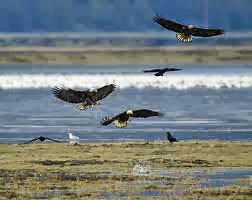
I sat in the car with the rain beating down and looked at the map for options. Klamath was hundreds of miles away. Then I remembered my last visit to Klamath. Bald eagles winter there. Lots of them. Did I snatch Sully from the talons of a Holland Lake eagle only to deliver him to an eagle smorgasbord?  Bald eagles at Klamath NWR


Eagles at Klamath by ibbuzz.com

Hwy 205, the long, lonely road out of Malheur

I decide that home where, this time of year, we have at least seven species of gulls, was my last, best option. 


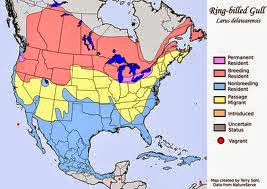
This is an adult Ring-billed gull in breeding plumage.
sdakotabirds.com
 These birds forage in flight or pick up objects while swimming, walking or wading. They also steal food from other birds and frequently scavenge. They are omnivorous; their diet may include insects, fish, grain, eggs, earthworms and rodents. These birds are opportunistic and have adapted well to taking food discarded or even left unattended by people. It is regarded as a pest by many beach-goers because of its willingness to steal unguarded food on highly crowded beaches. The gull's natural enemies are rats, foxes, dogs, cats, raccoons, coyotes, eagles, hawks, and owls .Wikipedia.com 

A birder I know said the true limiting factor for Ring-billed Gulls is the lack of parking lots.