Schlepping Sully Part V

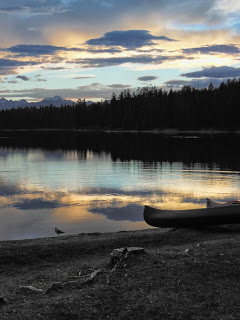
Flathead Lake by majikphil3.blogspot.com


Flathead Lake in Winter by brix.berg.com


Assured that there were gulls at Flathead Lake all year long, I left Holland Lake for the 50-plus mile drive north, where I expected to off-load my cargo, then return to Holland Lake Lodge with their pet carrier. The four mile drive over the washboard road from the Lodge to the highway was the longest of the entire trip. Poor, trusting Sully had been slapped into a cage, covered with a blanket, and was now being rattled about like a bean in a can. He flapped and paced for the entire drive. On the upside, I figured he'd never put his survival in the hands of another human being.  

Malheur NWR Oregonlive.com


An hour after leaving the Lodge, I arrived at the north end of Flathead Lake. I drove from point to point along the lake, scanning it with binoculars for gulls. There were none. I turned around and headed south on Hwy. 35, which paralleled the east side of the lake, pulling over at every opportunity to scope out the shoreline. I began to feel like an idiot for not trusting my instincts. Of course, there were no gulls. What would they eat over winter even if the lake didn't freeze, which I was told it never did. At the southern tip of the lake, I turned south toward Missoula. The next best option was Malheur National Wildlife Refuge, in southeast Oregon--a day and a half away.

About this time the Maintenance Required light that had been flashing each time I started the Prius, came on permanently.

I was south of Missoula on some back road, when I found a nice pull off and decided to see if feeding Sully would relive his unrelenting anxiety. The writers group had pitched in fish from our last meal at the Lodge. I had a Ziploc full of halibut, a couple of scallops, a lovely chunk of Panko-crusted trout, and some scrambled eggs. 

You may recall from Part I that I'd planned to camp both coming and going to Montana, so the entire length of the rear of the passenger side of the car was filled with a feather comforter folded in half. Behind my seat was a folding chair on top of which I'd placed Sully's pet carrier. A small cooler was behind the passenger seat with the head of the comforter covering it. My laptop and all associated paraphernalia were in a backpack, on top of the comforter, as was my suitcase. There was another bag containing a cook-stove, plate, cutting board, and utensils jammed in next to the cooler. Oh, and a bag of groceries, whittled down to crackers, a can of Wasabi peas, peanut butter, toilet paper and paper towels.

I failed to mention that I'd lined the bottom of Sully's cage with a couple sheets of newspaper for the drive to Flathead Lake. Not nearly enough, but like most smells you get used to them, and frankly, I kind of grew to like it. Anyway, I got some fish and eggs from the Ziploc in the cooler, then traipsed around to Sully's side of the car, open the cage door wide enough to get my arm in, and fed him. After that, he settled down.

I'd been up since before dawn and, with Sully quiet, I started to get sleepy myself. I was on Hwy. 93, which paralleled the lovely Salmon River. I found a wayside park, pulled in, climbed onto that down bed, put my legs on top of my suitcase, and fell asleep until Sully fluffed his feathers about 10 minutes later.

We're by then about 350 miles into the trip and the first night on the road to Malheur was looming. There were campgrounds along the river, but what were the chances I'd get a wink of sleep? I looked at the map and decided the next town I came to large enough to have a motel would be it for the day. What exactly I was going to do with Sully, I wasn't sure, but as we became fond of saying at the writers workshop. "I'll burn that bridge when I come to it." (This story is long enough without explaining how funny we thought that was.)
I owe them 4 stars. Northgate Inn, Challis.

 The Northgate Inn, Challis, ID. Their sign said, WiFi and pets welcome. It was family owned and the nice lady asked me, when I checked in, if I had a pet. I was honest. I said a bird.

"I won't charge you for it."

I'm pretty sure her mind went to a parakeet, or maybe a canary, but she didn't ask and I didn't tell her. Though my room was near the front, I parked at the rear entrance to the motel, checked that the coast was clear, and rushed down the hall with Sully's cage. 

When I checked in, I specifically asked if the rooms had bathtubs. I'm sure you can see my thinking here. They did and that's where Sully spent the night. I ran a little water in tub, and opened the cage door. He wasn't too eager to come out until I splashed water like a bird bathing. He couldn't resist then. I put the cage on the floor, and started filling the tub. It scared him at first, but with the shower curtain pulled, he couldn't get out. I filled it more slowly, and pretty soon, he was all in. He bathed with wing-slapping joy, not once but three times. I fed him, made sure the shower curtain had no gaps, and turned out the light. Night, night, bird.

I won't go into what the tub looked like in the morning. I drained it, fed Sully, refilled it so he could bathe again, then put him in his cage, and took a shower myself to rinse away any further evidence.
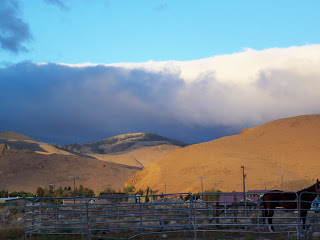
Sunrise in Challis, ID

I carry a Fort Bragg phone book in my car. I looked up my mechanic's home phone number and called to ask if I should worry about the Maintenance Required light. He said it meant I needed an oil change, and not to worry.


"I'm about 1000 miles from home."  

"You'll make it."

My second call was to Ron LeValley, an authority on birds. He said Malheur would be a perfect place for Sully, and if not there, try Klamath NWR in south central Oregon.
There was a little restaurant a block or two down the street. For breakfast, I ordered one egg over easy and one egg scrambled to go.
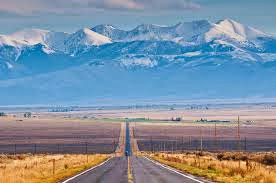
Hwy 93 out of Challis Flickr.com


In memory of Oscar "Bud" Owre
       on this his birthday


Schlepping Sully Part IV

I think this is Glacier NP from the Lodge
I was set to depart for home on Sunday morning the 22nd. On Thursday, I mentioned to the staff person who'd been feeding Sully (bread) for 6 weeks that, with any luck, I'd be taking him with me.
        "Oh no, she said. "I'd miss him. I'll take him to Flat Head Lake when I leave."

This played into all my trepidations about taking him. Was it the right thing to do? Would he fly out of here on his own when the time came? Had that time come and gone? What if there weren't any birds at Flat Head Lake? The only other birds on Holland Lake were a pair of mergansers, and a Western grebe. (Or so I thought.) And if there were no gulls at Flat Head Lake, what was I going to do with a gull in the car for the 4-day drive home?

If I leave him, I told her, will you stop feeding him bread? He needs protein--left over fish, scrambled eggs.

         "Gulls are scavengers," she said. "He'll be fine."

If she hadn't said that, I might have left him, but she was blowing me off. She'd been taking care of Sully for 6 weeks and here's some squat little old lady about to abscond with their mascot--her buddy. She couldn't have cared less about my credentials or whatever it was I thought I knew about birds.


To be fair, all the staff at Holland Lake Lodge is amazing. Every person knows your name by day two, and you are treated like family. It was one of the most pleasant experiences I've ever had--with the single exception of worrying about the damn bird.

There was a baby shower on the lawn the same day I revealed the plan to Sully's other mother. I totally understood that they didn't want the pet carrier in the view shed, but it went from being placed out of sight to disappearing completely.

At night I would sleep for a few hours, then wake and run all the scenarios on a loop in my head. If I was a normal person (and I mean that in every sense of the word) I would have let this go, deciding that it was their bird, so to speak, and that I should let nature take it's course. But then I'm not normal.

Those of you who have read Lost in the River of Grass may see reality playing out where only a fiction existed. I didn't see that link between me, and my struggle to do the right thing by Sully, and Sarah and Teapot, the baby mallard in Lost . . . until I was on the road home. Or for that matter, now that I think about it, Joey and Sukari, Hannah and Rega, and Buddy and Annie. It's who I am, and what I do, and the theme of every bloody book I write. Duh!

I went to Liz for advice. After all she and this group of writers were regulars; they'd already booked next year's dates. I didn't want to turn the whole place on its ear over practically the most common species of GULL on the planet. Bless her and them. To a person, they were in my corner and suggested I email the owner who'd left--poor guy--for a vacation of his own. I asked yea or nay, did he want me to back off and leave Sully there?

I spent another sleepless night waiting for his answer, not at all sure, he'd even check his email. The next morning I decided to ask the owner's mother. She said absolutely I should take him, and promised I'd get the cage back to me on Sunday morning. Of course, that meant no more training him to eat on the inside, but there was nothing more I could do. I knew for sure that I'd get one shot at him. During breakfast, she whispered that the owner had called her. They both wanted me to take him.

That night, I borrowed a sleeping pill from one of the other writers.

I packed up Saturday night and put most of my stuff in the car. I also moved it out of sight of the apartment where this staff person lives. The gull-napping plan was afoot. It was still dark when I woke Sunday morning. I looked out the window, saw the cage but the gate, and Sully standing in the yard looking at it. I grabbed my bowl of leftover fish, scallops, and scrambled eggs, and tiptoed down stairs. No one else was awake, so I crept outside, and moved the cage over by the door where I'd fed him before. Sully came running, but would have no part of going in after the tidbits I placed in the rear of the cage. I spent 30 minutes alone working on getting him in, then the yellow jackets showed up, and the first guests started trouping out to watch the sunrise.

Sully wasn't bothered by people walking in and out, but he'd have no part of trying to take something away from a yellow jacket. I removed the food, and went in to take the chill off by the fire. Breakfast was starting and the place would soon be swarming with guests. I wanted to cry. Instead, I defrosted my feet and hands and went back out to try again.

I placed a tiny bite at a time--afraid he'd get full and lose interest--first in front of the cage, then just inside. He snatched them in the blink of an eye. If he didn't get at least the front half of himself in the cage, I wouldn't be fast enough to get the door closed. My stomach churned, and my back was killing me.

The sun was up and people were headed back in for breakfast. I'd been at it for well over an hour. Scallops were is favorite. I gave him a tiny taste, then put another bite in the center of the cage. I heard the lodge door start to open, but didn't dare look up. I heard it close. Sully charged in, I smacked him in the butt, and slammed the door. I grabbed the blanket I'd brought from my car, covered the cage to keep him from squawking, and took off down the trail through the woods to my car.


At breakfast, one of the other writers asked if I'd seen the eagle.circling off shore yesterday morning? I had not, but now was pretty sure Sully's life expectancy had been that day or the next.

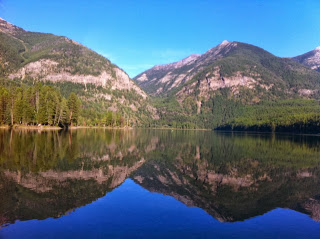
This is how clear Holland Lake is.

Schlepping Sully Part III


 I heard that. 
"I'm taking the time to read this and it's about a sea gull? Give me a break."

birds.cornell.com
By the second day at Holland Lake, when it was becoming clear what Sully's situation was, I was telling myself the same thing. It's a gull!

Some time in early August, a storm came through Holland Lake and the next morning there was Sully. (No one seemed to know who named him, but we can assume he's named after Capt. "Sully" Sullenberger, who landed his disabled jet in the Hudson River.)(For a time, he was also known as Little Dude.)

The staff at Holland Lake began feeding him (bread, mostly) and so did the guests. By the time I arrived in mid-September, Sully was a well-established mascot of the Lodge though no one was sure what he was. They thought he was a gull, but a guest had told them he was a tern. I was the first person in the five or six weeks he'd been there who recognized that he was an immature Ring-billed gull--specifically a 1st winter bird. (Many gulls go through a number of plumage changes before reaching maturity and their full adult plumage.)

For readers who don't know my background, I have an undergraduate degree in biology, all my electives were ornithology classes, and my senior paper was on the territoriality of Great White herons in the Florida Keys. I've done animal rehab for 30 some odd years, and am past president of our local Audubon Society. I not only recognized what he was, but also his fate if he stayed much longer at Holland Lake Lodge.

Everyone agreed that he'd probably been blown in from Flat Head Lake about 50 miles north northwest of Holland Lake. That's where they'd seen lots of gulls in the past. Their plan was to capture him when the Lodge closed for the season (October 14th) and take him to Flat Head Lake. 

The only person in this workshop I knew, and not that well, was Elizabeth Rosner, our leader. Liz taught a well-received workshop at the Mendocino Coast Writers conference a year earlier. I'd met her, but as a frenzied board member, never spent more than a moment or two chatting. Then, this spring I ran into her at Gallery Bookshop in Mendocino. She told me about the workshop in Montana and I signed up--admittedly because it was in Montana. So, while I started worrying about Sully right away, I was uncomfortable being too out there with my dire predictions for his chances of survival in a crowd of strangers, all of whom were friends, and this their third or fourth writing workshop with Liz at Holland Lake Lodge.
Me and Sully by Liz Rosner

I started my campaign by asking about an animal rehab facility in the area. There had been someone, but he'd died recently. Then I suggested that catching a wild bird, even one as tame as Sully, was going to be a challenge. They'd only get one chance, and it was likely that he would bite whoever grabbed him and, even though that wouldn't really hurt, the knee-jerk reaction would be to drop him, and that would be that. They'd close down, and he'd be left on a lake surrounded by deep forest and high mountains to perish with the first snow. (Actually, as it turns out, he probably wouldn't have lasted another day or two.)

By day three, Liz, bless her insightful heart, suggested I take him when I left. I could drive him to Flat Head Lake. I asked the owner of the Lodge, who was immediately on-board and gave me a pet carrier to put him in. The next step was to change his diet. Yes gulls are scavengers and will eat just about anything, but a steady diet of bread wasn't doing him any good. The writers started tithing fish from their dinners. In the mornings, I'd order two eggs scrambled--one for me & one for Sully. I also discovered there were lots of small grasshoppers in areas where the lakeside grasses were long. I got very good and catching them, trying to ignore the image I was presenting to the other guests. Though a couple of the Lodge staff continued to bring him bread, Sully stopped eating it. 

Sully & Christina
There was a lot of concern about whether Sully could fly. When he saw me, he'd run across the yard. It wasn't until Day 5 that I saw him fly, but only for a few yards. If a dog came into the yard, he'd run to the lake and float away. He also slept on the lake at night. 

One thing I wanted to do was get him familiar with the pet carrier. I put it outside on the south side of the front entrance, door open and started feeding him in it. As I said, Sully was no fool, but he also trusted me--totally. I figured if I fed him in it for a few days and the door never slammed, when it was time to leave, he'd have lost his suspicion of it.After a couple of tries starting with bits of egg or fish in front of the cages, and each subsequent bite placed further and further into the cage, he got more daring--zipping in and out to snatch the meal. Success was at head until the day of the baby shower.

Holland Lake north (I think) by Liz Rosner


Me kayaking by Liz

Sully video
Familiar acrobats of the air, Ring-billed Gulls nimbly pluck tossed tidbits from on high. Comfortable around humans, they frequent parking lots, garbage dumps, beaches, and fields, sometimes by the hundreds. These are the gulls you're most likely to see far away from coastal areas—in fact, most Ring-billed Gulls nest in the interior of the continent, near freshwater. A black band encircling the yellow bill helps distinguish adults from other gulls—but look closely, as some other species have black or red spots on the bill.  http://www.allaboutbirds.org/guide/ring-billed_gull/id

Schlepping Sully Part II

Have you ever heard the reason I moved to northern California? If you haven't, you're the only one. So I would never be hot again as long as I live.

A couple of years ago, when it was clear that I could no longer afford the gas to keep the battery charged much less take another road trip, I sold the RV. About the same time the Cash for Clunker opportunity came along and I got rid of my Ford Explorer. I now drive a Prius. Additionally, I'm not pleased about the fact I am three and a half inches shorter than my once full height of 5' 5", but it came in handy when I decided I would camp on my trip to Montana. Not in a tent. I'm way too old to be interested in that. In the Prius. I pulled the passenger seat all the way forward, placed a feather comforter the full length of that side of the car, added a sleeping bag, a couple of pillows, my little cook-stove (for coffee in the mornings) and a small cooler. I spent the first two nights at my friend's gorgeous 'beach' house in Yachats, then headed east. I watched the temperature going up and up as I got away from the Oregon coast. By the time I got to Bend, it was in the high 90s. I checked into a motel for the night.

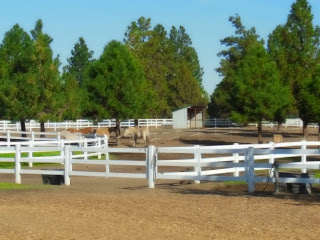
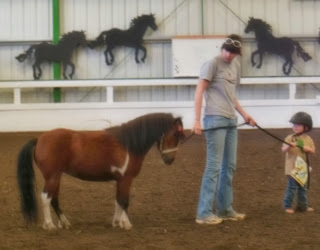
I went to Bend specifically to visit Healing Reins, a therapeutic riding center. A friend of mine is working toward launching a center here on the Mendocino coast. I wanted to make contact with one of the best.
                              http://www.healingreins.org/ 
 
When
Wednesday October 16, 2013 from 9:00 AM to 4:00 PM PDT
at Healing Reins in Bend


There were two new chickens in the carrier. I'm not sure of the message this little goat was sending them.
This picture is blurry because I was smiling too hard.
  http://www.nps.gov/joda/index.htm
                John Day website

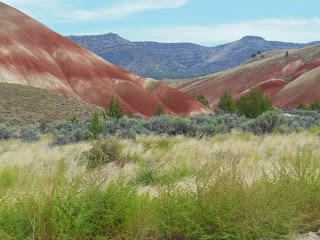
From Bend I drifted northeast, hoping for cooler weather. I'd wanted to visit the John Day Fossil Beds again, but it was 95 degrees there, so I snapped a couple of pictures and drove on to find a motel with a strong AC unit in Ontario, OR. That night there was a lightning and thunder storm that made this old fossil happy to be snug in her bed.

It was in Idaho I first noticed that 'deer crossing' signs had changed to 'game crossing.'

The next day the temperature was nearer what I thought I could cope with, and I was determined to camp on my last night before reaching Holland Lake Lodge where the writing workshop was to take place. I crossed Idaho and came into Montana through Lolo. That's where the big fire was earlier in the month. The aftermath, as expected, was sad, but it gave me renewed admiration for fire-fighters. I passed a number of houses that remained untouched by the fire which had burned all the trees around them. One right up to its back door.

Because of the fire, all the campgrounds were closed for the remainder of the season. I checked into a motel in Missoula. Missoula, BTW, is beautiful. They have an appreciation for trees that beats anything I think I've ever seen. From an over-pass, the tops of trees are all you can see in neighborhood after neighborhood. Very impressed.


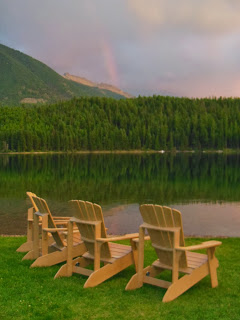
First afternoon on Holland Lake
See that bird on the shore? Guess who.

Schlepping Sully Part I

Hopi pronounced Hoppy
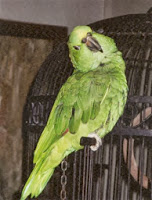
For the last two weeks I've either been driving to Montana, writing in Montana, or driving home. I logged 2927 miles. I decided to drive because I reread Steinbeck's Travels With Charlie this summer, and used to love to drive. When I moved to Fort Bragg from Miami I took a circuitous 9000 mile route, rambling through the five states that I had never been to: Arkansas, Wisconsin, North and South Dakota, and Montana. It took me seven weeks of traveling back-roads in the RV I bought expressly for the move. I was accompanied by my parrot, then only 11 years old, a tame white dove who sat on infertile eggs the entire trip in her basket which hung in the bathroom off the shower head, and an albino
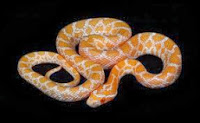
Rosie
red rat snake--one of my going away presents. Rosie lived 9 years. In Nauvoo, IL, I picked up a stray kitten. That trip was 22 years ago.


My trip to Montana started with a 10 hour drive up the coast to Yachats (pronounced Ya hots), OR. A dear friend moved there a few years ago and this was a chance for a visit. She took me to Newport where we visited the Hatfield Marine Science Center. They had truly interesting exhibits, but you know my fondness for octopuses. They have a Pacific Giant octopus on 'octocam' which they feed on Mondays, Thursdays and Saturdays at 1 pm. If you go to the octocam at that time, you can watch them feed her. http://hmsc.oregonstate.edu/visitor/octocam (if link doesn't work, copy and paste into your search engine.) 

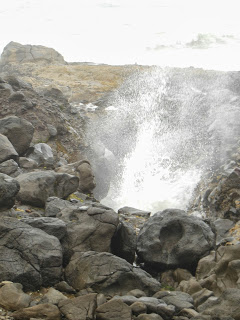
Waves at Point Cabrillo for example
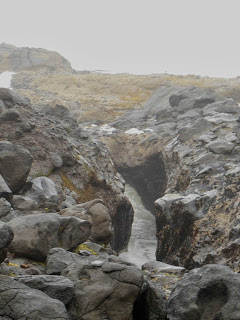
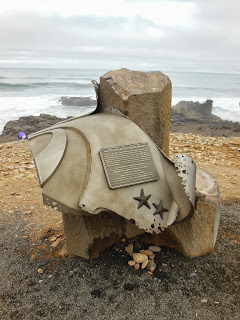
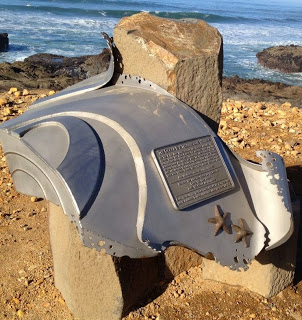
Another stop we made was to a memorial for two young men who were killed when a sneaker wave swept them off the rocks. I was so moved by the memorial one of the boy's mother had erected at the site, that I took pictures. Here on the Mendocino Coast, not a year passes that we don't have a fatal encounter with the sea. 


They were standing on the rock at the top of the picture 

And were swept into the crevice.


The memorial on a prettier day by Linda Watson


So who is Sully?
Wait for Part II in a few days.


Sluggo


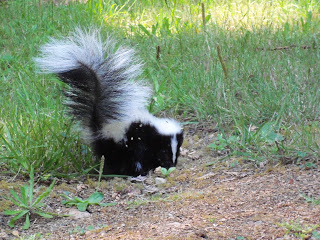
This is Sluggo, a baby skunk I rescued. The full story is on my website, which I've just spent the day editing, and up-dating. I've posted some pictures--animals and family history--and a few short stories.

I'm taking a couple weeks off to work on a new project, so I thought maybe you'd be willing to take a look at all the work I've done on the website.
                           www.ginnyrorby.com
(If this link doesn't work, click through via the link at the upper right hand corner.)


     I'll be back in touch toward the end of the month.


Back to Africa by Tanya Smart

Back to Africa
Once again, we spent too many hours in an airplane in order to spend too few hours watching elephants and the other wonders of the African continent. We journeyed in Southern Africa – 10 days in Botswana and four in Zimbabwe. Our Letaka Safari guide was Nkosi Sibanda who had showed us the wonders of the Okavango Delta two years ago. Enjoying our first African sunset at the Okavango River Lodge was made perfect by our first African Gin and Tonic.
Moremi Game Reserve in the Okavango Delta is the favorite part of our safari. Flying in over the delta looking for elephants and giraffe is spectacular, as is landing in the very small airplane on the small runway in the middle of the bush. The wildlife is used to vehicles so one gets up close views without feeling that you are disturbing or altering behavior. Among the first spectacular sightings during the three days was a daytime view of the endangered Wild African Cat. They look much like the average housecat and unfortunately will interbreed with domestic cats, as well as catch their diseases. The next day we watched and listened to two wild dogs that were vocalizing in an attempt to reconnect with their group. Their vocalizations were unexpected – not wolf-like howls or any sort of dog-like sound that I’d heard before but more like a high pitched keen. One dog would sound out, then both would listen intently – completely ignoring us. At a later time, Nkosi placed us perfectly to watch a successful wild dog hunt – chasing impala who attempted but failed to flee through water. We were sad for the impala that was caught and more so for another confused animal standing in the river watching the dogs and not seeing the crocodile who took advantage of the impala’s distraction. National Geographic photographers spend months in the field to film what we’d just seen in 30 minutes or less.
We watched a group of lions strategically place their sub adult males in clear view of waterbucks while the females attempted to circle around out of view. It didn’t work, thanks to some vocal francolins. It was then that we discovered that the battery on the truck was dead. Not to worry, it is easy to attract help if you tell the other guides that they and their guests will see lions.


Some of the lions we saw were little cubs the last time we were there. Mortality in lion cubs is high so there were fewer in the pride than two years ago but they looked healthy and well fed. Nkosi gave us good long times watching this pride as well as several groups of elephants. I could watch elephants for hours and never be bored.
While we were out looking for wildlife, lions and leopards visited our camp. In fact, each time that the camp staff went out for firewood, they had a spectacular sighting. We thought maybe we should go collect firewood with them. At night, with lions so close, the impala stayed closer – bedding down within sight of our campfire.
The next three days in Khwai we could venture out at night to see what might be there. Bouncing eyes meant springhares, more than we could count. Small feline predators such as Genets and Civets are out at night and their glowing eyes helped the diurnal humans find them. We possibly saw bush baby eyes. We sat (in our truck) outside an abandoned aardvark burrow at dusk, waiting until the hyenas and their cubs came out after dark. I am fascinated by hyenas so this was a true treat. As cubs nursed on what we assumed was the alpha female, another hyena paying very close attention until it was snapped at by the nursing mom. The chastised individual laid down in another spot and several cubs joined her to nurse. An adult of unknown gender (it is hard to tell with hyenas) brought out a piece of well chewed something to play “tug” with a pile of cubs. 
Nkosi found the wild dog den with a pile of puppies outside and helped us spot a female leopard and her older female cub. This momma leopard had a younger cub and it was unusual for her to tolerate her older daughter nearby. It was clear she was barely tolerating the adolescent as she vocalized warnings frequently. Sydelle’s goal of being the first to spot at least one animal was rewarded when she was the one to find the younger cub.
We had an unfortunately placed campsite in Savuti that meant long drives each morning to the spectacular Marsh. Nkosi and the camp staff made the best of it by packing our lunches each day so we could spend the maximum time out. We observed a group of elephants pass by some well-fed lions who had happened to take their siesta in the middle of an elephant trail. The elephants were almost stepping on the sleeping cats. Elephants can’t see that well, but they could clearly smell the lions. The lions weren’t rousing no matter what. A large number of elephant bones lying near roadways was the evidence of an extended heat wave that Savuti experienced in October/November of 2012. The elephants died returning from drinking, making us wonder if they had died from electrolyte imbalance caused by overdrinking after dehydration. 

We saw so many antelope that I can’t list them all but the second ever sighting of a bushbuck was a highlight as were abundant sightings of the magnificent Sable and Roan antelope. Though there are never enough giraffe or zebra for me, we did see quite a few. The giraffe in particular were less skittish than past visits. It was dryer than two years ago so perhaps they were more focused on eating.
Letaka specializes in birding safaris and though ours wasn’t a birding group, we saw lots and lots of fantastic birds. Lilac breasted rollers always got an Oooh and an Aahh. No wonder for a bird whose feathers represent the rainbow and looks like liquid turquoise in flight.
Our unfortunate campsite meant that we had limited time in Chobe and were unable to enter at the Ngoma gate on our last day. Chobe may be crowded with day trippers but it is also filled with spectacular wildlife in abundance. Our disappointment was quashed by the boat excursion where we were treated to several groups of swimming elephants. There is nothing more adorable than a swimming baby elephant.
This part of the trip ended in Kasane. One of these times we need to do the reverse itinerary so that I stop disliking Kasane – it is not the town’s fault but its association with the end of the safari that makes me dislike it. From here we transferred to Victoria Falls, Zimbabwe. Cross boarder transfers are interesting – enough said.
Our lodge in Vic Falls was beautiful without being snooty. One does notice the grime that one accumulated in the bush immediately upon entering a non-bushish establishment. We were suitable for the dining room after a long shower and change of clothes. The sound of the falls soothed us to sleep. We got up early to view this World Heritage Site before our 9am pick up for Hwange Camp.
Hwange Camp in Zimbabwe is a year old establishment that is structured to be comfortable, but not ostentatious. It was strategically placed and built to provide maximum views of the nearby large waterhole. A baby hippo had been born days earlier and was wonderful to watch. At night, one could hear the hippos and sometimes elephants munching vegetation outside the cabins. We met new friends from the UK on the way to Hwange who were our companions on safari for three days, and made more friends each evening over a scrumptious meal. 
Wildlife in Hwange National Park is not as used to vehicles or humans as that in Botswana though the wild areas are contiguous and presumably wildlife from one area can easily migrate to the other. The elephants were testier, the antelope shyer and walking safaris were possible. Coming upon a lion on its kill meant no tragedy for humans, just a scared lion (Brent was a little scared too – I didn’t see the lion). We saw lots of tracks but few animals while walking though we did see a recently killed civet in a tree – probably stashed there by the leopard whose tracks we were following. During our afternoon siesta by the truck, a group of elephants came close by which was quite wonderful. The other group had seen a lion kill a baby elephant on their way in. One guide said that elephants in Hwange often leave their calves behind when they go to drink. This was most certainly not the case in Botswana – the mother and entire herd protected and defended calves vigorously. This behavior has been described in studies where elephant herd social structure had broken down due to poaching of the older adults. We don’t know if that was what happened in Hwange but seeing different behaviors was interesting.
Our reason for visiting Zimbabwe and Hwange Camp was to see black rhino. Unfortunately, poaching in Hwange has reduced the population from around 45 animals to 4-6. The remaining animals were across the river in another part of the park and so this part of the quest was thwarted. Rhino horn is not medicine. 
Our first guide in Botswana said that you have to leave one animal to bring you back next time. This trip it was the cheetah – which we did not see. We’ll be back – though everyone knows that I come back for the elephants.


     All the pictures were taken by Tanya and / or Brent, her husband.

Blue Marble Gratitude by Katy Pye


kamidempsey.com


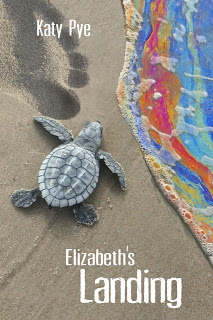
Elizabeth’s Landing and Blue Marble Gratitude


We writers sometimes characterize our lives as lonely. Huddled over paper or in front of computer screens, we spend uncounted hours in isolation. I suppose this portrait is more than half true. At the beginning and end of the day, it’s my rear in the chair, my vision, my brain, making decisions on where the plot goes, the look of the landscape, and how my characters feel and act.  I wield the power of the gods. At times curl up in despair of the forgotten.

People often ask why I chose sea turtles as the main animal characters for my novel, Elizabeth’s Landing. Survival. I’m moved by their 100 million year track record, despite what nature and people continue to throw at them. Turtles are cultural icons around the world, symbols of longevity, wisdom, and patience. They manage their own form of almost solitary living. Many times I felt like a world-wandering loggerhead or feisty Kemp’s ridley stubbornly, perhaps instinctively, pushing against or riding my story-telling currents.

But like the turtles these days, I wasn’t paddling alone. A small world of sea turtle conservationists, scientists, researchers, eco-warriors of all stripes, and, of course, family, friends, and fellow writers, each on his and her own path, gave time to support me and mine. All our effort culminated in a book launch at Gallery Bookshop. I had a blast. Joyful e-mails came from near and far. Standing room only. Lots of books sold. I read, answered questions, and shamelessly reveled in the moment. A tiny hatchling in a humongous author ocean.

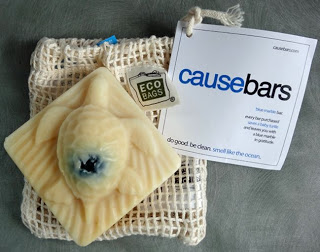
In such moments, one swims in an equally large ocean of gratitude. You can’t escape it. My character Elizabeth doesn’t act alone, and I didn’t either. So, how to give back? How to carry the moment beyond myself? One of my favorite authors, Catherine Ryan Hyde, wrote Pay It Forward, which started a worldwide movement. In the sea turtle world, the pay-it-forward guy is sea turtle biologist, educator, and conservationist extraordinaire, Wallace “J.” Nichols. His “Blue Marbles Project,” aims to pass blue marbles through the hands of every person on earth. Each marble is a symbol, a “celebration of our beautiful, fragile, blue planet.” The “rules” of the blue marble game are simple. The marble must be blue (duh), it is given with an individual message of gratitude, and the story must be shared. My blue marble came encased in a lovely, handmade bar of soap from SlowCoast. I passed it into the hand of an audience member at my launch, in gratitude for the support I’ve gotten writing and publishing Elizabeth’s Landing, and hope for our planet’s future. This post is my share.

I keep a turtle vase, the one Elizabeth gets from her mom in the book, on my desk, reminding me to keep paddling forward. Go the distance, be open to learn and to change (a.k.a. revise), to act and be grateful for whatever the outcome.
photo by Katy Pye

A challenge: Join the Blue Marble Project and go beyond the gesture. Find your own way to make change in the world. It doesn’t have to be big, it just has to be yours. Then share it.

This post is in memory of 26 year-old sea turtle conservationist, Jairo Mora Sandoval. May 31, 2013 while protecting critically endangered leatherback turtles, nesting on a Costa Rican beach, he was brutally murdered by alleged egg poachers with likely links to the drug trade. World-wide, reward money was raised, over 10,000 signatures petitioned police to step up the search for the killers. August 1, Todd Steiner, director of Sea Turtle Restoration Project (and others) delivered 137,000 signatures to Costa Rica's Consul General in Los Angeles, demanding justice for Jairo. Six suspects are now in custody. Individual voices, bonded together, continue to make a difference.


From the Center for Great Apes newsletter


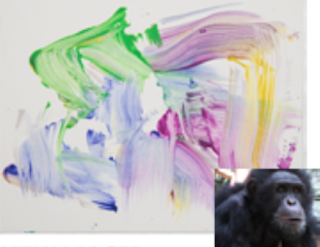
Please Vote for Ripley!

RipleyThe Humane Society of the United States (HSUS) is sponsoring
a chimpanzee art contest, with entries from six of the North American Primate Sanctuary Alliance sanctuaries across the U.S.  We have a great chance to win, so cast your vote today and every day until August 22nd .  First place winner will receive a $10,000 grant from HSUS! Please urge your family and friends to participate too – it's easy and only takes a few seconds to vote.  Just visit www.humanesociety.org/chimpart and cast your vote for our wonderful chimpanzee artist, Ripley! Don’t forget - you can vote EVERYDAY until August 22nd at 5 p.m.!
Blossoming New Friendship

Chuckie & Mari walkingFun-loving orangutan Chuckie, has made a new friend...and it's Mari!   The two redheads recently had a play-date, and boy, did they have a great time!  Our concern was how Chuckie would react to Mari who has no arms.  Even though Mari is about one-third the size of nearly 300-pound Chuckie, he was the one who was a little apprehensive when he first entered the habitat.  But after only a few minutes, they were sitting across from  each other and playing a very slow version of “tag.” Chuckie reached out 
Chuckie & Mari relaxing
and tickled Mari’s foot then sat back.  Mari waited a few minutes then stuck her foot out to touch Chuckie.  They did this for a little while, and then Chuckie decided to wander around the habitat.  Mari stood up and followed him everywhere he went.  Both orangutans eventually laid down- head to head- and played tug-of-war with a piece of pine straw!  Needless to say, it was a very gentle version of tug-of-war, but they seemed to really enjoy each other’s company. Pongo is still Mari's "main man", but one of the greatest gifts we can give our orangutan and chimpanzee residents are new and enriching friendships. 

WHY MARI HAS NO ARMS
Mari, a Sumatran orangutan, came to the Center from a research facility in Georgia where she was part of a language and cognition study. Mari is a very unusual orangutan in that she has no arms. She lost both her arms while still an infant when her mother, in a very agitated state, damaged her limbs beyond repair. In spite of the accident, Mari is a very capable orangutan. She uses her chin to hoist herself up, uses her feet as we would our hands, and she walks upright (or rolls when she wants to get somewhere quickly). Initially, we were concerned that she might have difficulty maneuvering in a new environment, but she quickly proved us wrong. She moves with such ease and grace that sometimes we forget that she is missing her arms.

When Mari first arrived at the sanctuary in 2001, she spent several months in quarantine (which is standard for new arrivals). Our first two resident male orangutans (Pongo and Christopher) could see Mari everyday from their nighthouse and were fascinated with her! They spent many hours watching Mari and often tried to get a reaction from her. The first week she arrived, young Christopher “dressed himself up” with celery stalks around his neck and on his head, and then paraded around in Mari’s view. He kept checking to see if she was looking at him. We’re not sure whether Mari was impressed, but he definitely had her attention!

Pongo and Christopher are the first male orangutans Mari had ever seen. She was gradually introduced to both boys and has lived peacefully with them in their large domed habitat, but if the boys get rowdy, Mari handles them either with a “kung-fu” kick, or a spit-in-the-face! When Pongo was an adolescent, but still much larger than Mari, he would retreat into a bucket or tub to get away from the intimidating stare Mari gave him if she wasn’t in the mood for play.

Many mornings, Mari climbs the ladder to the top of the 40-foot tall enclosure using her chin and her feet. And she likes to spend part of the day walking upright through the woods in the chute system. Usually, she follows Pongo everywhere he goes, but occasionally she likes to go out in the woods for time alone.

from the Center for Great Apes website. http://www.centerforgreatapes.org 

A Kid Who Wows Me

In June, I sent Jessica's story about her life with OCD. It had been chosen for NPR's Radio Diaries. Here it is again, but there is now more to the story. Jessica is reaching out to other kids with OCD. Please take a look at this link.
http://www.indiegogo.com/projects/camp-audeamus-a-camp-for-kids-with-ocd

I get lots of wonderful emails from kids. We usually write back and forth for a few weeks, then they get bored and move on. However, a few keep in touch, and Jessica is one of them. We've been writing for a number of years now. Jessica maintains a blog where she writes truly insightful comments on books she's read. I think this one is the link to Steve Job's bio.
and another for everything else  http://adhocfornow.wordpress.com

You can imagine how proud of her I am already, and then I find out she's been chosen to be included in NPR's Radio Diaries, which are personal stories written by kids.
Jessica's is the second one from the top. Click on the picture of HOPE. It's entitled Firsts and Fives.
 

The Circus is coming to Town

PLEASE DON'T GO
This video is infuriating and heartbreaking, but if it keeps you or anyone you know from paying to see the circus when it's in San Francisco (or any circus anywhere) then it's worth sharing.

If you can't stomach the video, then imagine what these animals endured to learn these 'tricks' for our amusement.

Would you pay money to see your neighbor beat his dog?

A Mouse can Dream by Prudence Breitrose


A Mouse can Dream


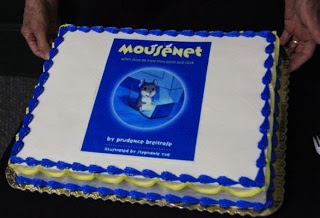
What does it feel like to have a first book out? Well, great, of course. But maybe it would have felt greater if I’d done a better job at managing my hopes and expectations for Mousenet before it was published, in November, 2011.

Yes, there were times in the run-up to publication when I thought the book might sink without trace. But at other times I couldn’t help giving way to “What ifs.” Couldn’t help noticing how some books by unknown authors rocket up in the charts. Couldn’t avoid seeing that word ‘debut’ in rave reviews. At Costco I even found myself visualizing Mousenet in their book section, selling in the millions–but why stop there? I imagined it boxed in a gift set with all its sequels, just like The Hunger Games.

It did nothing to dampen my hopes when a half-page article about me appeared in the San Jose Mercury News. It helped even less when the Merc reporter e-mailed to say that a Hollywood studio had been in touch with him, trying to find me.

And I had an extra reason for thinking my book might perhaps cause more of a stir than most. My mice, who have evolved and become computer-literate, slow down the rate of climate change. Shouldn’t that have got the book banned in a few southern school districts or libraries? And launched me into, say, an interview on NPR, or denunciation by right-wing commentators?

Fame, I was ready for my close-up. As one of my characters says, ‘A mouse can dream.’

It didn’t happen. No NPR. No attacks by Rush Limbaugh. No reviews in the mainline press. No movies (Hollywood decided it was too like Ratatouille.)

True, I had an excellent fifteen minutes of fame locally, finding at my launch party that I loved talking to a roomful of people. I wanted more–but more was hard to come by. For one thing (after saying, ‘we think this will be a big book for us’) Hyperion-Disney did nothing that I could detect in the way of promotion or publicity. Local children’s bookstores weren’t interested in hosting an event for an unknown. And schools? It took more than a year to arrange for a couple to invite me.

Mousenet sold quite well in its first Christmas season, then settled down to ‘chug along,’ as my editor put it, heading into a steady decline over the next year.

True, that year did bring experiences that were priceless. I was invited to make a few appearances–mostly in front of other writers–which helped me realize how very lucky I was to have a book out at all. Then there were the comments from kids themselves, who don’t hold back. Nineteen exclamation points. Seventy six. The best book ever. The second best book ever. If you haven’t read Mousenet you haven’t lived. Kids telling me that they were in pain, aching for a sequel.

This enthusiasm renewed my desire to push my book out there, to get it under the noses of more readers. If it had been my real child, instead of a virtual one, this was the point at which I would have paid for tutoring. For a book, that translated into trying to create a buzz on the Internet.

Not that easy, as I found out. I did try my hand at tweeting, and collected a few followers (two of whom tweet in Norwegian). I also found my way onto some climate-change sites, which gave the book nice reviews. But after a nice little spike in sales when the paperback came out, Mousenet resumed its steady decline.

Until–KABOOM!

I was on vacation in the Middle East when–without any help from me–Mousenet went off to Florida, made friends with people of influence, and got itself nominated for the Sunshine State Young Readers Award of 2014. And this, as Ginny knows, is a big deal (she won the YA award this year with her great Lost in the River of Grass). Weekly sales of Mousenet immediately shot up to more than twice what they’d been at the launch.

So let’s hope thousands of Floridian third- through fifth-graders read Mousenet, and send me emails or Facebook posts covered in exclamation points, and realize that they don’t have to wait for the sequel because Mousemobile will be out in October, and they’ll buy that book too, and maybe write to their uncle in Hollywood about how there could be a great movie and. . .

Stop it!

I shall school myself not to expect too much of Mousemobile (or Mouse Mission or Mouse Menace, which I hope will follow) so that whatever happens will be wonderful.

 
Prudence's last blog post for me was her rescue of a rat named Fido.

On this Blog's two year anniversary... a poem to Lily by Suzanne Byerley


Suzanne Byerley


Lily, I missed you this morning
          but here's what I saw......

Dozens of big and little white daisies
Bazillions of buttercups beaming
Lotsy of flopsy-winged creamy butterflies clapping
Just two teensy yellow ones fleeing
One dark green oak tree (you know the one)
Fat purple clover blossoms
Lavender wild geraniums jiggling
Two kissy-red wild roses
Milkweed coming along
Calf high corn
A solo orange tiger lily singing (just for you) and four billion buds
Packets of weensy gold pocketbook posies
(Somebody filled up the big groundhog hole in the road!)
And from its skinny little stem, one bedazzled blue chicory blossom
hollering "Lily, Lily."

Come home soon!

Suzanne wrote this poem to her granddaughter, Lily, while Lily was visiting her father. They were in the habit of taking 'nature' walks. What a gift Suz was to all of us.


Lily

Friends


flickriver.com

I've been out of town for a week, and the rest of this week will be taken up with our 24th annual Mendocino Coast Writers conference. www.mcwc.org  

P.S. For writers suffering in the heat, the fog is in on the coast.

In the meantime, enjoy this little film.

http://bbemaildelivery.com/bbext/?p=video_land&id=698ef524-730d-4afa-9e78-aea9d16ecf9f


A reminder to Suzanne's friends, her
 memorial will be Friday the 26th, 4 p.m. at
the College.

Amelia Island Osprey by Sandra Baker-Hinton


travel-usnews.com

An artist friend in Florida, Sandra Baker-Hinton, sent this to me after I sent her the link to the Maine Osprey nest Live Cam. Sandra is also involved with sea turtle nest monitoring. This is her blog

We have a little drama going on with our (Osprey) nest here on Amelia Island. I snapped these photos this morning as I left the park after turtle patrol. (The nest) was mounted high on a pole just beside the original nest after the old nest kept falling piecemeal onto the power lines below. Nice to have them care enough to do that for the birds rather than just tear their nest apart. The ospreys took to the nest right away and built yearly right on schedule, except for the year the owls beat them to it, but the minute the owls left with their youngsters, the Ospreys moved right back in.  We have a rather informal group which communicates by email and tries to monitor and report to each other any news from "the pole".  We call ourselves the "pole watchers", and have taken the names for the Ospreys from another fellow who works down the street and watches them also. He calls them, Alpha (the male) and Little Girl (the female of course). Last year we were very sad when the storm, Beryl, drowned the new chicks in the nest.  Alpha and Little Girl went through the motions of rebuilding their nest but when the nesting hormones subsided they finally abandoned their efforts and did not get to raise any in the 2012 nest.  This year things were off to a good start, with no damage from any of the early storms, and two hatchlings in the nest it was determined by "the pole watchers."  Then we began to suspect something had happened when we could only spot one of the parents feeding and caring for the young. Usually the male hunts while the female stays at or nearby watching the nest. Now there was never anyone there except at feeding time. Then a report came to one of us that an Osprey had been found very nearby in the middle of the road with a badly broken wing. Our worst fears were confirmed, tempered by the glimmer of hope that the other osprey was at least alive. The bird was taken to B.E.A.K.S, a wild bird sanctuary, where we found out it did indeed have a very badly broken wing, and although it will live, the bird will never fly again in the wild. The next chore is to identify which bird was hurt, as none of our photos of the remaining parent have been good enough to see if it has the distinguishing "necklace" of the female but we feel pretty sure that Little Girl is the one now feeding and nurturing the chick. We will know for sure when I go to B.E.A.K.S. to get some photos of the Osprey, there and do a story about them.  We have one chick remaining in the nest and are hoping the other one just fledged early and did not get eaten by an owl or eagle. The photos today are of the remaining osprey chick which is almost ready to leave the nest.  Poor Little Girl is such a trooper to work so hard as a single mom to hunt, feed and raise the chicks alone.  

thefreshwaterfly.com

This is the live cam on the Maine Osprey nest. The babies are growing like weeds.
Learn more about ospreys
http://animals.nationalgeographic.com/animals/birds/osprey/


Responsible or irresponsible?

During a recent classroom interview, the teacher asked me to tell her students what I'd like them to remember. They'd read Hurt Go Happy. You would think, after 30 years of writing, I'd know what I wanted my take-home message to be, but I had to stop and think. What was my sound bite? What could I say that they would remember?

When I was growing up my mother took me to the Sanford (Florida) Zoo. I was only 6 or 7, but I remember feeling sorry for the animals. Sixty years ago, it was a horrible place. All the animals were is small cages, and people would throw peanuts or popcorn or the butt end of a hot dog bun at them, trying to get a reaction--some display of emotion. I've never been to another zoo, or a circus, or to a Sea World-like aquarium except to do research. Decades have passed and we still keep animals in cages, and whales and dolphins in concrete tanks, then starve them so they will do tricks for food. We lock monkeys and chimpanzees, dogs and cats in cages and test chemicals on them.

So what do I want from you? I hope, if you go to a zoo, a circus, or an aquarium, or see a commercial or a movie with an animal in it, that you will ask yourself where did that animal come from, and what was done to it to make it do what it is doing to amuse me? Then I want the life it's living to break your heart.


Once in 26 years was enough by Ronnie James


Long-tailed weasel
500px.com


Pop Goes the Weasel

At Point Cabrillo Light Station a few years ago, I, and a steady stream of tourists, watched one Long-tailed weasel consume an entire family of gophers. Gopher holes are connected underground and our lighthouse weasel spent over an hour--undisturbed by the audience--popping out of first one hole then another. I can also personally attest that nothing scares a weasel. I had one in my yard some years back, and watched him/her keep five cats at bay, circling, snapping, and charging them until they threw up their paws and withdrew.

As an aside, here on the Mendocino Coast gophers are the ban of every gardener, but we might well be speaking Russian if it weren't for them. They made farming so miserable for early Russian settlers that they gave up and left, but not before they wiped out the sea otters as far south as Big Sur. Sea otter recovery, from the small population discovered there a few decades ago, has been slow and to date only reaches as far north as the Farallons.

brdpics.blogspot.com
LTW in their northern range turn white
in the winter.


Weasel Rescue by Ronnie James

Someone found a small ball of fur curled into a tight ball sleeping on the sand in the middle of a vast beach south of Mendocino. It slept peacefully when they picked it up, so they took it to a State Park ranger who called us. This was Woodlands Wildlife's first long tailed weasel in 26 years, so I spoke with a friend at a large facility that was experienced with weasels. Interestingly I learned that most weasels that come into rehab are found this way--curled in a ball asleep in an exposed place. Some can be handled and don't wake up. If they do, they just look around and go back to sleep. However, within a few minutes, of being fed and watered, they turn into killing machines. In spite of their diminutive size they possess large strong jaws and rows of shark-like teeth which they use to bite and viciously attack anything in range.

I gave it some water and food, then watched in amazement as the docile creature lunged at and tried to attack anything near its cage--my hand and the forceps I use to push the food into it's cage, and it grabbed and tore apart the paper cup I tipped through the bars to pour water into its dish. It even spread the fairly heavy wire bars on it's cage, but fortunately not enough to get out. Then it chewed a clothespin to smithereens and went back to sleep.


I am finally understanding the story in my book about the woman who raised one as a pet and when it was a few months old, it was sleeping in her lap and suddenly leaped up and tore a big gash in her hand requiring a trip to the emergency room and stitches. It probably went through puberty while it was asleep on her lap and woke up a normal adult weasel. I was able to keep weasel in the cage for 2 days during which time this 8-inch-body-plus-5-inch-tail ate 4 adult mice (already purchased dead and frozen from a wildlife food provider) each day. He also used a litter pan (pie plate) and the room began to smell a lot like dead skunk. Weasels are members of the skunk family. I wasn't going to get into the cage to clean him, and he certainly had enough energy to be out killing his own food, so I released him near a meadow and stream with lots of mice and gophers to hunt. There's one animal I won't mind not seeing for another 26 years. --Ronnie James


Ronnie James
Woodlands Wildlife
Woodlandswildlife@mcn.org
www.TouchingWings.org

To learn more about our local Long-tailed Weasel and for great pictures of them, follow this link.

Victory for Chimpanzees!

  
This week, the National Institutes of Health made their final determination regarding the future of using chimpanzees in research.  After going through the 13,000 individual comments that were submitted during the public comment period this spring, the NIH has decided to significantly reduce the number of chimpanzees in research.  A little over 300 NIH-owned chimpanzees will be released and up for retirement in the coming years.  The Center for Great Apes applauds this decision that is definitely a step in the right direction.  We look forward to continue to work with the sanctuary community to get ALL chimpanzees out of research.  
However, the NIH plans to keep 50 chimpanzees behind for future research needs.  They are not allowed to breed these individuals, and must meet the newly accepted recommendations set out by the Council of Councils Working Group such as space requirements, “ethologically appropriate” enclosures (i.e. those that would occur in natural surroundings), etc.  You can read more about the NIH’s decision here: http://www.nih.gov/news/health/jun2013/od-26.htm
Pant hoots to the beginning of the end of chimpanzees in research!

Toddy with her Wubba toy
Address postal inquiries to:
Center for Great Apes
PO Box 488
Wauchula, FL 33873-0488
Powered By
eTapestry

Hopeful News, Bad News

The United States Fish and Wildlife Service proposed Tuesday to bring captive chimpanzees under the protection of the Endangered Species Act, a move that would create one more major barrier to conducting invasive medical research on the animals for human diseases.


If the proposal is enacted, permits will be required for any experiment that harms chimps, and both public and privately financed researchers will have to show that the experiment contributes to the survival of chimps that remain in the wild. The recommendation is now open to public comment for 60 days.


The demand for chimps in medical research has dwindled, and the National Institutes of Health is expected to respond to recommendations from its own committee to retire most of the about 450 chimps it owns or supports. The committee recommended keeping a colony of chimps for possible future research on human disease if needed, but that need is not one of the criteria that the Fish and Wildlife Service would consider.

Daniel M. Ashe, the director of the Fish and Wildlife Service, said the proposal would end the so-called split list, with wild chimps declared endangered since 1990 and captive chimps unprotected under the law.

The move was a long time in the works, a response to a petition filed in 2010 by the Humane Society of the United States, the Jane Goodall Institute and other groups with concerns about biomedical research on chimpanzees and the use of the animals in advertisements and entertainment.

TO READ THE ENTIRE STORY 

The article goes on to say that if this passes, it might not protect chimps in the entertainment industry. We have to do that by withdrawing support for any film or commercial that uses a chimp or orangutan.

While the argument for medical research has been that there is a compelling human need, he said there was no such argument for using young chimps in television advertisements, for example, which he described as “entirely frivolous.”

But under the Endangered Species Act, only uses that are considered harmful or harassing require permits. And use in entertainment has not traditionally been considered to be in the same class as taking blood or other invasive procedures.

In separate interviews, Mr. Pacelle and Dr. Goodall said chimps who are trained for entertainment are taken away from their social group when they are young, which is very harmful to them. And, Mr. Pacelle said, once the animals reach the age of about 7, they become too strong or unruly, and the owners “typically dump them into the animal welfare movement for us to care for for the next 50 years,” at a cost of about $1 million over the lifetime of each animal kept in a sanctuary.