Action Readers


I got a Google Alert that Hurt Go Happy was being reviewed on a new blog so, of course, I peeked. The review is very nice and, as always, I'm grateful, but more importantly this site encourages readers to read and take action. I'm rather into that concept myself.


Nag. Nag. Have you called in support of the bill to protect primates in research? H.R. 1512


Here was Laurie's comment following the review:


My Action: I'm going to round up a crew of people to go see the new documentary Project Nim when it hits my town the week of September 8, then double check that I am not personally consuming any goods or services tested on animals. (I'm pretty vigilant about this, but it's easy for a new product to sneak through...)


Another comment the site inspired came from a teacher: "I think my action step will be to grade my students next papers "blind." That is, I'll have them put their Uni ID on them instead of names, because the protagonist in The Way Things Are blatantly favors one of her children. I want to make sure I don't favor any of my 'kids' (or the reverse.)"


The blogsite is Action Readers http://whatsheread.blogspot.com/ Read Widely. Act Joyfully. Change the World.




How are my daughters?

We writers create characters who become part of the family, in my case, my daughters. If we are lucky enough to get published, they go off into the world, then, in most cases--disappear. I have some vague notion of how they are doing. I get the ocassional letter home in the form of a royalty check, but I don't really know how they are faring out there in the world with millions of other fictional characters. Are they making the kind of difference I'd hoped they would make?

Then a letter like this comes in . . .


"I recently read your novel, Hurt Go Happy. I read the novel to educate myself about books that were worthy of one of the American Library Association awards.


I felt a kinship with the main character, Joey Willis. Joey is isolated from the rest of the world by her inability to hear. I can hear, but can only communicate with people who can read my lips. Like Joey, I seem to always be on the periphery and your portrayal of her loneliness and apartness was spot-on.


I am a legally blind, ventilator-dependent quadriplegic. I do have the ability to speak out loud, but require someone to monitor my ventilator and adjust my tracheotomy tube. When I choose to speak I must be conscious of triggering the ventilator for every breath, and it's extremely taxing. LIke Joey opts out of hearing with her hearing aids, I opt out of speaking. It seems to be too much trouble.


I wanted to tell you the story touched me. Your writing style thoroughly engaged me and drives me to continue plugging away at writing books for chilren and my inspirational articles and essays for adults. Thank you for writing an entertaining and thought provoking tale."


Jessica Aday Kennedy
The Differently-Abled Writer & Speaker


Children's Author of Klutzy Kantor, Marta's Gargantuan Wings & Stella the Fire Farting Dragon.


http://jadaykennedy.blogspot.com/
http://www.jadaykennedy.com/
http://brainfartexplosion.blogspot.com/


Jeremy and Geronimo


This letter is from Jeremy's mom. After reading The Outside of a Horse, she took the time to write, and was kind enough to send me this picture of Jeremy and his friend, Geronimo.


"My son, who is 12, and I have read your book. After he read it, we decided to volunteer at one of the horse rescue facilities near our home. I started riding horses when I was 13 and I owned 2 . . . because when I get a horse, I commit to it fully. Jenny, my quarter horse, was euthanized 3 years ago because her arthritis was so severe. She was 24. Because I really have a hard time saying goodbye, I haven't had any more. Your book made me cry so many times. The grief I felt each time I had to say goodbye to my beloved horses came up several times while reading. Your book inspired us to get involved. I thought I was okay with not having horses in my life but after volunteering, I realized that they are and always will be a huge part of my. Thank you for the beautiful story and for the inspiration." Penny in Colorado


There is a bill in congress, sponsored by
Roscoe Bartlett, (R) Maryland, to stop unnecassary testing on primates. Bartlett, who was the inventor of respiratory devices tested on primates in the early days of the space age, is now against their use for research, especially drug research. The link to the NYTimes article is below.


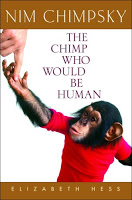
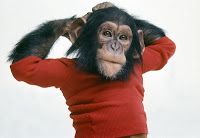
Project Nim, a new release from Sundance Films, documents the 27 year life of Nim Chimpsky, a chimpanzee who was raised as if human. I based Hurt Go Happy on Lucy Temerlin, another experiment is raising a chimpanzee like a human child, and Nim Chimpsky. Sukari is their fictional counterpart. Here is the chance to end the suffering of the nearly 1300 chimpanzees still in research facilities.


The bill is H.R. 1513. Please support it by contacting your House Representative.


The link for the documentary, Project Nim, is http://sundance.bside.com/2011/films/projectnim_sundance2011


The link to the NYTimes article about Bartlett's House bill is


Collision Course?


You'd think anyone in her right mind would be scared to death to see a 45 foot whale headed toward the 16 foot long boat, you're bobbing in. Not in the lagoons for San Ignacio in Baja. I can promise we were all hanging over the side with our hands reaching for him or her, hoping for contact with this amazing (lame word) animal. This one is an adult gray whale. You can tell by the array of barnacles. A gray whale can accumulate up to 400 pounds of barnacles and whale lice while in these warmer waters then, as they migrate north to their summer feeding ground around Alaska, the barnacles and lice fall off, leaving the 'gray' scars that give these whales their name.


You haven't lived until you've kiss a free, wild whale.

This is me touching a baby gray whale. You can tell
it's a baby by the hair folicles--those dents on its head. This was taken two years ago in San Ignacio lagoon, one of the warm water lagoons of Baja where the grays give birth every spring. These birthing lagoons were discovered by whalers in the late 1800s, and hundreds of thousands of gray whales were killed, driving them to the brink of extinction. Now, unbelievably, mother whales seek out this encounter with humans. Once you have touched a whale, you will never be the same.