Requiem for a Great Horned Owl by Maureen Eppstein

 I'm so intimidated by poets, especially the ones who seem capable of reaching through your rib cage and playing with the rhythm of your heart. Maureen is that kind of poet.
itsnature.org

Requiem for a Great Horned Owl
by Maureen Eppstein

A warm late summer afternoon at Stanford University. I’d found a shady grove to sit and eat my lunchtime sandwich. As I strolled back to my office in Encina Hall, the administration building, I noticed several co-workers clustered under the huge live oak in front of the building, hugging each other and gazing at something on the ground. Uneasy, I hurried to join them. The looks on my friends’ faces confirmed my fears. ”Our” Great Horned Owl, who regularly roosted in the oak, lay crumpled on the ground.

I glanced back at the old sandstone building behind me. That spring, the owl and its mate had nested on a fourth floor windowsill of Encina’s east wing, which had been gutted by fire in 1972, ten years earlier, and was now uninhabited by humans. We delighted in seeing the fuzzy owlets emerge from behind the broken and boarded-up window and perch precariously on the stone sill. Owl parents returned with food, such as gophers and ground squirrels. Interoffice memoranda reported on the babies’ progress in learning to fly. 
flickr.com

That year had seen a huge increase in ground squirrels on the university grounds. We learned that the groundskeepers had laid an anti-coagulant poison to try to reduce the damage to trees and bushes. The most likely cause of the owl’s death was a poisoned rodent. Angrily, staff and students demanded that the Grounds Dept. cease using the poison.

They desisted for a while. But fourteen years later, a local newspaper, the Palo Alto Weekly, did a follow-up story. It quotes the Manager of Grounds, who does not recall that there was a clear link between the death of the owl and ground squirrel poison. But whatever was said 14 years ago, one thing is clear. Stanford is once again controlling the ground squirrel population with poison. For nearly a year, Stanford has been killing ground squirrels by giving them food laced with an anti-coagulant, which causes the animals to internally bleed to death over several days. The program has upset campus bird watchers, many of whom remember what happened to the owl family.

This year, I decided to follow up. I read on Stanford’s website that the university had launched an Integrated Pest Management program in 1997, the year after the Palo Alto Weekly article appeared. Since then, the Grounds department at Stanford has been dedicated to using an integrated pest management approach to provide suppression and long-term control of pests on campus, with the least amount of impact to the environment, non-target organisms and human health.

Herb Fong, who was Grounds manager during the 1980s and ‘90s, is now retired, but agreed to inquire on my behalf as to the department’s policies. Today I had excellent news. Herb writes: “I confirmed with staff that they are continuing to use trapping as the means to control the ground squirrels and no baits are used on the campus.”

If an 8,180-acre campus, mostly woods and grasslands, can stop using poisons, so can any other property whose owners care about wildlife.


10,000 Views!


This is a thank you card.

With the help of my friend, Susan Bono, I started this blog last August. As of today, the site has had just over 10,000 views.

At first I couldn't imagine what I would find to write about even once a month, much less twice a week. As you know, I've had help from others who are also working to help animals--wild and domestic. And I suspect most of the visitors to this site are the choir. You care about what I care about. That's okay. That's a good thing.

When these pictures arrived a couple of days ago, I felt my heart swell. I'm sure many of you have seen them, but enjoy them again as a thank you from me for taking the time to care.


I wish you this kind of bliss,

LOVE, Ginny

Sand Bees


blogsmonroe.com


Is it just me?

One of the main industries here in Fort Bragg was forestry. Since 1852, when Jeremy Ford arrived on the Mendocino Coast from Gold Rush San Francisco to salvage what was left after the wreck of the Frolic, (yet another story) which was carrying supplies from China for the miners, our trees have been under siege. San Francisco was growing exponentially, to the point where when a ship arrived in the harbor, the crew would abandon it for the gold fields, and the ship would be dragged ashore for housing. No fool was Ford. He saw our trees and an industry was born. Within two years every cove on the Mendocino Coast had a mill. Our timber built the city of San Francisco--and rebuilt it after the 1906 earthquake.

What has this got to do with Sand Bees?

The Georgia-Pacific lumber mill here in Fort Bragg occupied 400 oceanfront acres. For decades the site was off-limits to the public. (Still is for the time-being, even though the mill itself closed a number of years ago.) This means that in spite of the massively destructive business of milling timber, there are relatively pristine areas left on that site. A couple of years ago, I was lucky enough to be involved in surveying where interpret signs should be placed once it is open to the public. That was the first time I saw sand bees, and was immediately smitten. The friend I was with told me what they were, and that the female lines her underground nest with a waxy substance, and that the burrow is somehow shaped so it doesn't flood. How could you not love that little bee? So when I was trying to think of a subject for this blog, I remember those sand bees, and Googled them. The first site that came up was this one.

  How to Kill Sand Bees | eHow.com  http://www.ehow.com/Lawn & Garden 


Does it seem odd to you that, if you are the least bit curious about anything, the first thing offered up is a way to kill it? Or is it just me?

Here's more information on the Digger Bee, or Sand Bee: 


Digger Bee is a common name for a group of robust, fast-flying, ground-nesting bees with velvety fur. These bees live throughout the world. There are several thousand species, more than 900 of which occur in the United States and Canada. Digger bees visit a wide variety of flowers and are important in pollination. They are also called long-horned bees due to the exceptionally long antennae of the males.


Digger bees range from the size of a honey bee to as large as a bumble bee. These bees mostly nest in the ground and line their brood cells (compartments for offspring) with a wax-like secretion. In some species, the females construct a characteristic turret, a chimney-like extension of the nest entrance. Digger bees display very interesting nesting and foraging behavior. Many species nest in dense aggregations, and swarms of males cruise around the nesting sites searching for emerging females. In one species, the males can detect the females in the ground before they emerge. These males dig a hole into the ground where the female will emerge and then await her arrival. Other males attempt to take over and fights ensue. The largest bee usually wins.


A species of digger bee called the southeastern blueberry bee specializes on blueberry plants in its pollen-collecting. It is more efficient at pollinating these plants than honey bees or bumble bees. Another species, the pallid bee, puts on spectacular displays of mating behavior in the spring around nests in desert washes in Arizona. The Pacific sand dune bee is a digger bee that nests in coastal sand dunes in California, Oregon, and Washington. The females dig nests 0.9 m (3 ft) deep in compacted dune sand.


Scientific classification: The digger bees comprise the subfamily Anthophorinae, family Anthophoridae, order Hymenoptera. The southeastern blueberry bee is Habropoda laboriosa, the Pacific sand dune bee is Habropoda miserabilis, and the pallid bee is Centris pallida.
http://www.everythingabout.net/articles/biology/animals/arthropods/insects/bees/digger_bee/

http://forum.beemaster.com/index.php/topic,16877.0.html 
This by ILoveMyAnts in NJ. A really lovely man. He's got some great pictures of his digger bees.

http://www.youtube.com/watch?v=74bJfEPpgow
This is a video of a female excavating her nest.


Bits and Pieces


My first guest blogger, on August 15, 2011, was my friend, J. Aday Kennedy. I thought you'd like to see this inspirational interview with her.

http://www.youtube.com/watch?v=lVP0wMpQMio
 (for some reason, known only to blogspot, you'll have to copy and paste the link)
http://jadaykennedy.blogspot.com/
http://www.jadaykennedy.com/
http://brainfartexplosion.blogspot.com/   

The illness and stroke that left Aday a legally blind ventilator-dependent quadriplegic, failed to dim her love of life and determination to spread a message of inspiration and hope.

Joan Hallmark shares Aday’s story of triumph over tragedy in a memorable interview. In the fourteen years since becoming disabled she has cried and laughed her way through the hard times. Aday’s “CAN DO” philosophy shapes her speeches and writing.
Her writing has appeared in many newspapers and magazines including five inspirational essays  in the popular Chicken Soup for the Soul books. Currently she is writing her memoir, “Laughter Through Tears,” about her physical and spiritual recovery.


 ***


In a December 16th post, I wrote about Johnny, my bathroom bat. I'm happy to report he's back for the 7th year in a row.

                                          ***

Lost in the River of Grass received an honorable mention in the 2012 Westchester Fiction Awards  


***


I'm going to watch this tonight, with my heart in my throat. 

A Project Nim is now out on Netflix

Making a Mountain out of a Molehill?

A couple of days ago, I was in one of our local feed stores buying The World's Best Cat Litter...which actually is the best I've found even though it is depressingly expensive. Behind the counter was a sign advertizing something to kill moles on sale for 50% off. I asked the young man ringing up my sale what it was.
          "It mimics the worms they eat."
          "So it's poisonous?"
          "Oh yeah," he said, pleasantly.
          I then proceeded to lose it. "That is so stupid. Moles do more good than they do damage." I grabbed my cat litter and stomped out.
          Since then, I've felt bad. Both of our feed stores, all our hardward stores, and all the grocery stores in town carry products to kill what we consider "pests." They are supplying what people want to buy. It would be nice if they had a clue about the ramifications of all those toxins, but like that kid I yelled at, they don't.
           A couple of days later, I was offered a load of firewood by an elderly man in our community. He's a volunteer at a local non-profit and he was helping split some trees that had been removed. While we were talking, I noticed he had a box of mole killer in a bag on his front seat.
           "Moles are good," I said, lamely.
          Years ago, I saw a maintenance man at our local college opening one of a dozen gopher holes and pouring poison in. Here on the north coast of California we do have a terrible gopher problem (which saved us from all speaking Russian)(see my comment)--a totally unwinnable gopher problem. (I know unwinnable is not a word, but it should be.) I was then, and still am, a volunteer at that college. I marched straight into the dean's office, and she put a stop to the college using poison right then and there.
          So here I am, sorry I yelled at that kid, and hopefully trying to convince a few more people not to use poisons to eliminate anything, but especially not moles. Is a bumpy little trail in a lawn really worth poisoning a myriad of underground organisms? (I won't ask about having a useless lawn in the first place.) I'll just give you some facts about moles:
  • Diet
    • They eat grubs, earthworms, beetles, beetle and other larvae, ants, wasps, flies and other insects.  
    • That is why moles are often a 'menace' on golf courses and in lawns. The use of fertilizer and the care of grass attracts worms and grubs, which in turn attract moles.
  • Benefits
    • They keep the earthworm population in check; People think earthworms can never be a bad thing, but in fact they can. Too many earthworms cycle forest litter too quickly, causing topsoil loss, and nutrient loss.
    • Their tunnels aerate soil; plant roots need oxygen; mole tunnels provide habitat for salamanders (which eat slugs), snakes (that eat moles, voles, mice and gophers,) lizards, and ground dwelling bees.
    • They eat insects.
    • Their tunnels create channels for water to run off, preventing damaging erosion.
  • Poisons used to kill moles applied in your home and landscape can move (through those same tunnels) and contaminate creeks, lakes, and rivers which, in our case, all lead to the ocean.
    • Here's a warning from UCDavis: Confine chemicals to the property being treated and never allow them to get into drains or creeks. Avoid drift onto neighboring properties, especially gardens containing fruits or vegetables ready to be picked.
I'm always tempted when I read a warning like this to say, WHAT ARE WE THINKING? Why would we risk poisoning our own property? Most of us have wells, and the ones who don't get their water from the Noyo River. Where do we think the water in our wells comes from, or the water in the river? And do we think that the only creature we are going to kill is our target pest? That it will conveniently curl up and die underground. What about the worms that eat its remains, and the birds in our yard eating those worms?

I've done bird rehab for years. Once you've seen an owl or a hawk die from eating a poisoned "pest," you will finally get it. Here on the coast the main predators on gophers are Great Blue herons, housecats and the voracious long-tailed weasel, which can wipe out an entire colony of gophers in an afternoon. The American kestral's main food source are voles. You poison one, you poison them all.

Long-tailed weasel
itsnature.org

PRECAUTIONARY STATEMENTS
HAZARDS TO HUMANS AND
DOMESTIC ANIMALS
CAUTION:  Keep away from humans, domestic animals and pets.  If swallowed, this material may reduce the clotting ability of the blood and cause bleeding.
NOTE FOR PHYSICIAN: This product reduces the clotting ability of the blood and may cause hemorrhaging.  If poisoning occurs, intramuscular and oral administration of Vitamin K1 are indicated, as in poisoning from an overdose of bis-hydroxycoumarin.  For human cases, Vitamin K1 is antidotal at doses of 10-20 mg total (not mg/kg). For animal cases, Vitamin K1 is antidotal at 2-5 mg/kg.  Repeated doses may need to be given up to two weeks (based upon monitoring of prothrombin times).

ENVIRONMENTAL HAZARDS

Do not apply this product directly to water, or to areas where surface water is present or the intertidal areas below the mean high water mark.
 REALLY?

Why Write?


There are days when I sit at the computer, hour after hour, and wonder why? Why sit here day in, day out reordering sentences and paragraphs, putting commas in, taking commas out of what I wrote just moments before, or a month ago, or, in the case of Girl Under Glass, the book I'm rewriting now, five years ago? It has already been rejected 6 times.

That was also the case with Hurt Go Happy. I spent years researching and writing that book, only to have it come back rejected over and over again. Then my agent quit me, and finally, after 15 years, I gave up. For the next three years, I continued to attend my writing group, but never turned anything in. I'm not sure what changed my mind about giving up. Maybe it's the idea that quitting ends whatever chance you had to make your dream come true, or your hard work pay off. 

Most of you know the rest of the story. What you might not know is the working title of Hurt Go Happy, American Sign Language for the pain has ended, was Without Voices.  I believed when I started researching and writing that book that it would give voice to the voiceless--abused children and abused animals. Big dream.

In the years since HGH was published, I've received a handful of letters that made those 18 years worthwhile. This is one of them. Oh boy, is this one of them!

Dear Ginny Rorby,

My name is Rosa Rodriguez. I am the Deaf Literacy Coordinator for the Pinellas Public Library Cooperative in Florida. I am working with the middle school teacher at Morgan Fitzgerald Middle School in Largo, Florida, who has a reading class of five 8th graders who are Deaf. 

These five students have never enjoyed reading.  National research done at Gallaudet University in Washington D.C. says that the average deaf high school student graduates at a third grade reading level.  It has been our passion to drastically change this sad statistic.  For these students, reading has been an arduous task that was always a requirement.  In an effort to show them the beautiful world of reading, the teacher decided to do a read aloud, Hurt Go Happy.

Hurt Go Happy opened a whole new world for the students.  For the first time, they truly learned the beauty and magic behind a book. They laughed imagining Sukari signing and cried when Dr. Charlie died.  They longed to yell at mom when she was oppressive to Joey and clapped when Joey fought back.  As a class they learned about social issues such as animal testing and the effects of abuse. They also went on a journey of emotions together- the steady wave of pain and joy.   

The teacher says: "Because of your book, their lives have been and will be radically changed. They would always ask if we could read one more chapter or stay past the bell just a few more minutes. They truly understand the feeling I-just-can’t-put-it-down.  To me, I saw a miracle happen in my classroom.  For maybe the first time in their lives, they fell in love with a book."

For their graduation of 8th grade on June 8th, we are requesting a letter to the students that we can read aloud at their graduation ceremony.   The Deaf Literacy Center at our public library will be purchasing your book as a gift to the students and we would love to include your letter with the book.

With sincere thanks,

Alissa Matiya
Deaf Educator
Morgan Fitzgerald Middle School


Rosa Rodriguez, MS

Deaf Literacy Coordinator
Pinellas Public Library Cooperative, Inc.

Hurt Go Happy Commercial   by Alissa Matiya's deaf students

http://www.facebook.com/n/?video%2Fvideo.php&v=10100585925956710&mid=5d2b823G3f515651G34bc912G1d&bcode=MXbwnVXj&n_m=ginnyrorby%40mcn.org

And now a word from my sponsor

 
More about me by Kayleen Reusser 

Kayleen Reusser is an author of children's non-fiction books. A newspaper columnist and speaker, Kayleen lives in Bluffton, Indiana where she also works in the Bluffton Harrison Middle School Library. She is the author of numerous children's books, and is best known for her biography of Taylor Swift and Celebrities Giving Back. 

Kayleen was kind enough to ask to interview me. :-)
http://kayreusser.wordpress.com/articles/


And your reward: a good laugh.
http://www.youtube.com/watch?v=kbVe8s9ryEg

The Joy of Killing

popfi.com

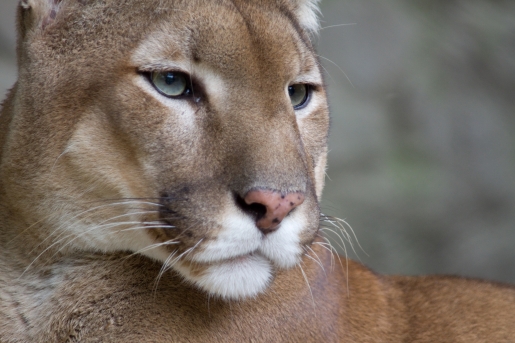
I've never understood hunting. I can't wrap my head around the need to kill an animal for the pure joy of taking a life, so when our California Fish and Game Commissioner accepted a $7000 trip to Idaho and killed a mountain lion for sport, I added my voice to the choir calling for his resignation.
I haven't changed my mind. I still think his behavior is disgusting, but I wasn't going to make an issue of it on this blog. Then my friend, Tanya, sent this to me. She's so much more reasonable about this kind of thing than I am.


The recent blow up over a California Fish and Game Commissioner shooting a mountain lion in Idaho is being portrayed as radical animal rights versus radical hunting. I believe this is obscuring the point. I am ambivalent about hunting but was fed by my hunting father for the first 5 years of my life and was paid to conduct environmental education programs in under-served schools by a non-profit associated with hunting. I agree with many of the precepts of animal rights but reject many of the more radical actions that some of these organizations undertake.

The issue to me is one of judgment. This person was appointed by the Governor to oversee the Department of Fish and Game, the agency that grants hunting licenses, oversees regulation enforcement, and interacts with the Federal Government on management plans for Endangered Species recovery. As long as he is Commissioner, he represents the Department of Fish and Game and his actions are a reflection on the Commission. The reflection from the photo of him holding a dead mountain lion in triumph is not attractive. To many of my hunting friends using dogs to tree a mountain lion so that it can be shot is not hunting, it is target practice. To most of us, an appointed California Fish and Game Commissioner accepting such an expensive trip as a gift from a person who would make more money if more people used his company looks suspicious.

Hunting whales is legal in some countries but that does not mean it would be wise for an American member of the International Whaling Commission to participate. Hunting elephants is legal in some countries but that does not mean it would be smart for a representative of the Species Survival Plan for elephants in the United States to go hunting elephants in Africa.

Just because something is legal it behooves us to think about the consequences before we indulge. I think this Commissioner should lose his position, not because he shot a mountain lion legally in another state, but because of the clear lack of judgment he showed in doing so.

Tanya

Dan Richards with his kill.


Point Cabrillo Light Station


Painting of the Light Station
by Lynne Prentice

I started by leading bird walks at the Point Cabrillo Light Station in 1996, and ended up as president of the non-profit that operates it. I'm still on the Board of Directors.

My favorite time of year to be at the lighthouse is now. March is when the gray whales are migrating back to Alaska, which can be a hazardous 6000 mile journey.


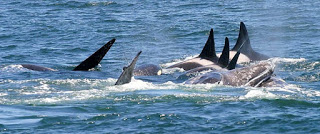
Below is a photo of Orcas attacking a gray whale. A few years ago, people witnessed just such an attack in front of the lighthouse.

Point Cabrillo and the tall ship, the Lynx
by Harold Hauck
That's a Coast Guard cutter on the right


The 3rd Order Fresnel Lens is back in service
in the Lighthouse
 Thanks to Bruce Lewis for the video.
This is also the time of year when the Harbor seals give birth, often on the rocks only yards offshore from the lighthouse. Within two hours of being born, the baby follows its mother into the ocean, frequently reappearing in the cove just to the east of the lighthouse.
Harbor Seal and Pup by Ron LeValley

THE 2ND WHALE FESTIVAL OF THE MONTH TAKES PLACE ON MARCH 17th & 18th

West Indian Manatees

Photo by Doug Perrine
Seapics.com

When I was in my early teens, (pre-Disney World) growing up in Winter Park, FL (which was sort of surrounded by Orlando--even then) my mother would force my sister and me to ride with her every Sunday to visit my grandmother, who had advanced dementia. She was in a home in Orange City, which is north of Orlando and Sanford, but south of Deland. (The building that housed the nursing home is still there.) This was before Interstate 4, so the drive, which seemed interminable, took nearly two hours--each way. Our reward for behaving was to stop at Morrison's cafeteria on the way home, where I would make a meal out of cooked carrots, string beans, and mashed potatoes with a pool of gravy in the center.

If we'd only known. Right there in the heart of Orange City, is the turn off to Blue Spring, the home of the largest congregation of manatees, anywhere.
      
 http://www.savethemanatee.org/manfcts.htm


Manatees are a migratory species. In the summer months, they can be found as far west as Texas, but summer sightings in Alabama, Georgia and South Carolina are more common. In the winter, they are concentrated in Florida, where they disperse in search of food during the mild days. However, cold weather can kill a manatee, so when the temperature drops, manatees by the hundreds seek refuge in the warm, crystal clear springs of central Florida. The water that feeds these springs bubbles up from underground caverns, and is a constant 74 degrees. Visiting Blue Spring on a cold winter day is an amazing experience.

Meanwhile, I lived in Florida all my life and had never heard of a manatee until the water hyacinth population got out of control in the canals in south Florida. One suggested solution was to put the mostly herbivorous manatees in the canals to eat the hyacinth. I'm rather sure this didn't work, since they are grazers on algae and sea grass.


In 1984, I did my senior paper in Biology at University of Miami on the territoriality of Great White herons in the Keys. (A story for another time.) The number one killer of the slow moving manatee are boat propellers. Most of the manatees in Blue Spring can be individually identified by their propeller scars. My Great White heron study was conducted along the canals of a housing development in Tavenier in the Florida Keys. Every afternoon, a lone manatee would travel up the main canal to a fueling dock. You knew she was coming by the warning shouts of "manatee in the canal" shouted from neighbor to neighbor, and at any passing boat. When news of her arrival reached the fueling docks, someone would put the garden hose over the side of the sea wall, turn on the freshwater, and toss a chopped-up head of lettuce into the water for her.

Note the propeller scars on the mother manatee's back.

Twice I got to lie on my stomach on the sea wall, feed lettuce leaves to her and tickle her belly. Once--because someone told me it would be an interesting experience--I put my hand in her mouth. I've tried to describe the feeling, and I think it most closely resembled being munched on by a thick bristled, very malleable back scrubber. It indeed felt strange, and didn't hurt, so been there, done that.


The date of this email from Ron LeValley is December 10, 2005.

"Ron’s Outside My Window is a recent photo that I have taken. It usually has some natural history theme (but sometimes not) and I sometimes miss a few days and catch up later. Much of the reason that I send out these pictures is to increase awareness of the natural world, awareness of the wonderful things that are ‘outside’ our windows, beyond the insulation that that much of our daily life imposes on us. Please feel free to pass this photo along to anyone you think might be interested. If your e-mail box is getting too full, let me know and I will remove you from the list. I also appreciate comments or questions about the photos, and any way you think this effort can be improved. Enjoy (and) take the time to look outside your windows!"

Burrowing Owl by Ron LeValley


Since that Dec. 2005 email I've been saving some of his pictures in file marked Outside Ron's Window. A few weeks ago, I asked him if I could post one once in a while. "Of course," he said.

When I asked him if I could use his amazing wave shot as the wallpaper on my blog he said, "Of course." 


I met Ron nearly twenty years ago when I was president of our local Audubon chapter. I invited him to give one on the dozens of talks he's since given to our chapter. That's not counting all the pelagic trips he's lead. In all those years, I've never asked Ron for a single thing, that I didn't hear "of course." No one I know has. Not the Study Club, not Point Cabrillo Light Station, not the City of Fort Bragg, not the Audubon Society. He never says no. He is passionate about his family, his community, and the natural world, and we all richer for knowing him. (And he's one of the few people who knows where our Blue whale is buried.)


To me, his photographs are a window into his soul. He is honest, loving, gentle, and generous. Please join me in supporting him, and his family.


Updates, Odds and Ends

  
A friend recently told me she tries to watch a TED talk a day. I checked it out, and the first one I found was about octopuses. You know I'm a sucker for anything to do with octopuses. 

http://www.ted.com/talks/mike_degruy_hooked_by_octopus.html


  http://www.ted.com/ 


Sammie look alike
Lost and Found was a November 23rd post about Sammie, the little dog that showed up on my doorstep. He was so terrified of men that the couple who took him had to give him up, and he ended up in our local shelter. Weeks went by, then I heard that he's been adopted--this time by two women.


And then there was Guest Blog: My Life by Jeremy Cimino August 28th.

Jeremy now owns Geronimo 


Guest Blog by Sallie Reynolds: The Gift of Flight

 
I had a poisoned wild Red-tailed hawk in my care for three months, and we came to know each other well. If we hadn’t, this story might have ended differently. I’m a licensed, trained wildlife rehabilitator, one of those nutty people who (legally) treat injured, ill, or orphaned wild animals. About 50 percent of the animals in our care grow strong, cured of whatever brought them in. The other 50 percent die. For the nature lover, these are heartbreaking odds.
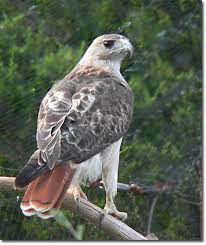
My Red-tailed came from a golf course. That season, our group had taken in a number of poisoned raptors from that area where the greens had been sprayed with pesticides. The raptors would eat a poisoned ground squirrels, and slowly lose control of their bodies. The feet go first. Then the wings. Then the head. Golfers saw my hawk tumble to the ground, unable to take wing again. They called a near-by rehabber, who picked up the bird and took her to a veterinarian. From there she called me – I suspect because she couldn’t stand watching another beautiful bird die.
My bird was large. Her great size and her coloring indicated a mature female. She was bone thin, and appeared paralyzed. Hawks cannot move their eyes much under the best circumstances, but hers, unmoving as they were, were still fiercely alight. As I watched, her beak opened. Normally, she would have screamed her fury, but not a sound emerged.
 Her neck was golden, almost like a Golden Eagle's, her crest high, and that open jaw was mighty. How beautiful! And so unlike the blur of a bird you see flying overhead. Here every detail was exquisite, each breast feather perfectly marked, as if someone had taken a little paintbrush, dipped it into a sunset, and applied it to her bib.
At my little “clinic,” a shed converted into a bird hospital, I injected Lactated Ringers, a hydrating fluid, under the skin between the top of her leg and her body. This bird was so dehydrated, the skin stood up in a peak when I pinched it. Afterward, I put her in a box, covered it with a towel, and went in the house to do some research.
I had notes from several groups on how to treat poison cases. None very hopeful. After I'd read awhile, I called a woman who works with eagles. She had released 38 that year, among them a few she'd pulled through a poisoning.
“Expect the worst,” she said. "The bird might not live the night. But if it does, there's a chance of recovery." She had a protocol that might help. It would be a long haul.
The next morning, my hawk was alive.
More fluids, more rest, more dark. The next day, she tolerated yet more fluids and a thorough exam. She was still unable to move, and a matted vent indicated an intestinal disturbance. A flaring of feathers over one eye suggested neurological involvement. I cleaned her up and fed her watered-down baby-food meat with a gavage tube (gavage = delivering a liquid via tube directly into the crop.) I did this five times a day.
Throughout, she was calm. For four days, I kept up the routine, flushing and re-flushing her system. On the fifth morning, she'd lost so much weight, it was frightening. And she refused to open her beak. I was losing her after all.
I looked at my notes: “She will tell you when she's ready for the next stage.”
Maybe, just maybe. I offered fileted bits of mouse. And oh how she ate – polishing off nine small mice in 20 minutes!
Three days later she was eating chopped mice, laced with vitamins, taking the bits from my glove. In a week, she'd put on weight and could stand on her own. I let her free in the room, and while I cleaned, she  staggered around, using her wings as crutches (not the time to worry about feather damage!).
backyardbirdcam.com

In another week, she was eating voraciously and hopping onto her crate. Twice a day, I held her by her upper legs, and let her exercise her wings. A few days later, she flew from one side of the room to the other, landing imperfectly.
“Wobbly is good!” I told her.
Sure enough, she soon had her feet under her.
Then one day she wouldn’t come out of her crate. Poison cases can break your heart this way; they can do so well, and suddenly crash.
But I hadn't forgotten my list: “She will tell you. . .”  So I decided to risk her in a flight cage. When I set her on the ground, she walked two steps – and flew!
Another month of flight exercise and good food, and my hawk was ready to fly free. We wanted to release her into her old habitat, which would be familiar and where she probably had a mate. The golf course manager had stopped using the poisons, so we took her home.
I lifted her our of her box and opened my hands; she sat very still, looked at me, then with a cry, she flew into a tree. Suddenly another Red-tail appeared overhead. My hawk cried again – and he answered. A moment later, the two joined in a spiraling dance, up and up, until they vanished into the sky.

Note the errant feather on the top of the bird's head.
That was part of the syndrome, nerve involvement in a poisoning. 
takethemoment.org
http://www.indiegogo.com/Help-Save-Hawks-1

At the of this rescue, Sallie was an active volunteer for Sierra Wildlife Rescue 
paulnoll.com

The Red-tailed Hawk (Buteo jamaicensis) is a bird of prey, one of three species colloquially known in the United States as the "chickenhawk," though it rarely preys on standard sized chickens.[2] It breeds throughout most of North America, from western Alaska and northern Canada to as far south as Panama and the West Indies, and is one of the most common buteos in North America. Red-tailed Hawks can acclimate to all the biomes within its range. There are fourteen recognized subspecies, which vary in appearance and range. It is one of the largest members of the genus Buteo in North America, typically weighing from 690 to 1600 grams (1.5 to 3.5 pounds) and measuring 45–65 cm (18 to 26 in) in length, with a wingspan from 110 to 145 cm (43 to 57 in). The Red-tailed Hawk displays sexual dimorphism in size, with females averaging about 25% heavier than males. (From Wikipedia)

FYI
I am often asked about the Audubon International stamp of approval on golf courses. Audubon is not a copy-rightable name, so in 2004, the PGA form an alliance with Audubon International, created specifically give the impression that a specific golf course has gone through a rigorous reveiw by environmental specialists. Audubon International is in no way associated with the National Audubon Society, and it's stamp of approval on any golf course in no way guarantees that they do not use pesticides, or excessive amounts of fertilizers. It also doesn't mean that they aren't doing the best they can for their business, and the environment.

When I wrote Sallie about this, she added this addendum:
Today many organizations that used to use organophosphates improperly -  too often and too strong - may well monitor their usage more closely. Otherwise, we'd see more poison cases. When it's freshly sprayed on the trees, or the greens, raptors (and other predators) can get poisoned not only by eating poisoned rodents and insects, but from perching on the fresh, too-strong solution. 


Guest Blog: Linda Bonvie--Comparing apples and oranges


As I wrote this, it looked perfectly normal: Times New Roman 12pt. When I hit preview, it is in all caps. I have no idea why, and I can't make it stop. I am not shouting at you.

We've all seen the ads where a mom reaches past a myriad of orange juice cartons, and is handed a fresh carton by a guy in an orange grove. I know those ads are bull, so why was I surprised to discover there is nothing "fresh-squeezed" in orange juice, (the fresh flavor is added just before packaging) and that there is enough pesticide residue in our orange juice supply to alarm the powers that be at Coca Cola?

So okay, duped again. We like to feel good about healthy food and beverage choices. Orange juice is full of vitamin C and calcium, and only a trace or two of a not-so-healthy ingredient. And then there was that reassuring network news interview with a Walter Middy-like spokesperson from the FDA. He promised that there is no need to worry. In my case, that's probably true. I am a child of the 50s, no doubt, still brimming with residual DDT & malathion, and can remember stirring that glowing orange glob of coloring into a white brick of oleo-margarine to make it look like butter. So why would I choose to do a post about orange juice? Because I was talking to my friend Bill Bonvie, Linda's brother, about it and he told me Walter Middy the 2nd used to work for Monsanto. That reassuring spokesperson worked for the largest producer of pesticides in the world, the same company that is trying to genetically modified everything we eat. Really? I was outraged.

 From Bill:

"Michael R. Taylor (or "Mike Taylor," as he was recently referred to by Dr. Richard Besser of ABC News, as in "I just got off the phone with Mike Taylor at FDA") is your quintessential revolving-door bureaucrat, having gone from being a staff attorney for the FDA to attorney for Monsanto, back to the FDA where he was largely responsible for the approval sans safety testing of Monsanto's genetically engineered crops, which were deemed to be "substantially equivalent" to conventional ones, as well as the administering of rBGH, the Monsanto growth hormone many researchers consider carcinogenic, to dairy herds to make them produce more milk. He subsequently went to the USDA as administrator for Food Safety and Inspection, then returned to Monsanto in another position (vice president for public policy), only to pop up again (surprise, surprise!) at the FDA under the Obama administration as deputy commissioner for foods, or "food safety czar." This guy gets around!

Comparing oranges and apples: the whole story about a prohibited pesticide


As you probably know by now, a  fungicide banned in the U.S. called carbendazim was found in imported orange juice. Discovered by Minute Maid – the orange juice giant owned by Coca Cola — the find was reported to the Food and Drug Administration. The agency swooped into action, writing letters to the Juice Products Association, testing orange juice and assuring us that the levels detected pose no hazard.

At the same time, the FDA declared current supplies of orange juice A-OK to drink, it also said orange juice arriving at the U.S. border  with any “measurable level” of the chemical  would not be allowed entry.
So which is it? The juice is safe if it’s in the store, but not if it hasn’t crossed the border? And what about the fact that residues of the banned chemical, also known as MBC, are allowed in other fruits that make up popular juices such as apples, cherries and grapes, and found to be perfectly fine by the FDA?
First, we need a little primer in what’s going on here, and to do that, we need to skip over to the Environmental Protection Agency (EPA) for a minute.

When it comes to pesticides in foods, the EPA can be thought of as the judge and the FDA as the cops. In other words, the EPA sets what are called “tolerances,” the legal limits of pesticides allowed as residues in food, while the FDA enforces that limit, with the authority to stop and recall foods that contain detectable residues above what the EPA has established. (Note that the word “safe” isn’t used here. A “tolerance” is basically what’s been determined at one point or another to be a level at which a chemical has “no effect.”)

Back to the orange juice: MBC, a nasty chemical that until several years ago was allowed to be used on Florida oranges, is currently on the banned list, considered “illegal” by virtue of there being no EPA tolerance set for it. So it makes sense that the FDA would stop all orange juice heading our way that contains it.

What doesn’t make sense is a sort of  FDA slight of hand that allows for MBC residues to be present in numerous commodities, even though the chemical itself has no food uses.

A case of ‘pesticide identity theft’?
How can this be, I hear you asking. Well MBC has a close relative called thiophanate methyl (TPM for short) that is allowed to be used on crops – quite a few, in fact. And after it’s used on strawberries, apples and blueberries, for example, it starts to degrade and turns into other chemicals, one of them being the banned MBC. In fact, when testing for residues of the permitted TPM, they look for, and measure it as … MBC.

In a attempt to show how safe our orange juice is, in fact, FDAimports.com, a private consulting firm founded by a former FDA employee, issued a press release with the headline: “FDA cracks down on Carbendazim (MBC) in OJ but ignores it it other foods…”

The moral of this appears to be that our news is creatively delivered to us. While headlines from papers all over the county and news anchors are talking about an “orange juice recall” and discussing whether it is warranted or not, what reporters aren’t telling us is that the same dangerous and banned chemical that caused the OJ scare is allowed on many other fruits used to make juice – with “permitted” residues at much higher levels than what caused all the to-do with the oranges.

Of course, such pesticides could be avoided by buying nothing except certified organic juices, but for a great many shoppers, that’s simply not an affordable option, since organic juices at best tend to be considerably more costly than their conventional counterparts.

For most consumers, a more practical solution would be for public pressure to force the regulators to abandon the double standard now being used in regard to MBC by prohibiting use of any other chemical that morphs into it as well – in effect, a form of  ‘pesticide identity theft’.

Telling us all about this, of course, should be the media’s job – but right now, rather than getting the whole story from them, all we’re hearing is what the FDA has to say about the chemical in oranges, while apples are given a pass. To say nothing of strawberries and blueberries.

Linda Bonvie,
FoodIdentityTheft.com

Linda Bonvie is an author, and consumer advocate with over 20 years of experience researching and writing about food safety, health and environmental issues.  She is the co-author of Chemical-Free Kids: How to Safeguard Your Child’s Diet and Environment (2003) and Chemical-Free Kids: the Organic Sequel (2008), as well as The Stevia Story: a tale of incredible sweetness and intrigue (1997). Articles she has co-authored with her brother Bill have been published in a number of magazines and many major newspapers. (One of these, an expose on the spraying of passengers on international flights with a toxic pesticide, which was published back in 1993, led to the requirement being dropped by a couple dozen countries after then-Transportation Secretary Federico Pena became personally involved in the issue.)

Guest Blog: Cheryl Gillmore

A couple of days ago, I mentioned I was in St. Louis on a panel reviewing writing samples of 8th and 12th graders. I've since heard from a number of you wanting to know more. As it happens, this morning I got this blog post from a fellow panelist, Cheryl Gillmore, also a writer, and she said everything I would have said, only better.
 
      This past week in St. Louis I had the pleasure of serving on a federally funded NAEP panel to set up and review writing samples of 8th and 12th grade students. Our job, after two days of training, was to establish the "cut scores" that divide the three levels of achievement...advanced, proficient and basic.  

      Seventy percent of the panelists were teachers or non-teacher educators representing nearly every state in the union--including Hawaii and Alaska. The other thirty percent of us were "general public," with nearly all of us writers.
   

      We stayed at the Ritz-Carlton in Clayton, Missouri, a suburb about 20 minute from St. Louis and enjoyed great rooms, great service and great food! Those incentives seemed to balance the long brain-draining hours of hard work each day in our training and subsequent scoring sessions.

      I was reminded of the love and dedication of teachers this week as I had the chance to talk and socialize with them again. It didn't matter what part of the country they came from, they were all equally concerned for the success of each of their students. I will always be proud to be a forever teacher.

      I will always remember this great week spent with truly wonderful and dedicated people. I'm so glad I was chosen to be on the panel and that I was open, accepting and positive for this opportunity and experience to come into my life.   

Once again, I am reminded... 

"A page turned...new chapters begin. The sequel yet to unfold.  
Never forgotten and never to end. Images etched on each soul." 
C. L. Gillmore is a retired special education teacher for whom writing has always been an important part of life. "My second grade teacher was a big influence," Gillmore says. "She was instructive and encouraging and made me love putting my thoughts on paper."

A transplant from Muscatine, Iowa, Gillmore resides in Surprise, Arizona with her husband Mike. She has two adult children and five grandchildren. She is writing a sequel novel to Uncommon Bond sure to please her growing fan base.

Home again, Home again, Jiggity Jog


For the last week I've been in St. Louis on a Federally-funded panel set up to review writing samples of 8th and 12th grade students. Our job, after two full days of training, was to establish the "cut scores" that divide the three levels of achievement.

I'm a better person today than I was last week. I, and 59 other panelists, worked from 8 a.m. to 5:30 p.m. every day for 4 days, and a half day on Saturday, before shipping out for our home states. I've never been so exhausted, and was reminded how lucky I am to be "retired."

If you are interested in looking at what I was doing here's the website. Seventy percent of the panelists were teachers representing nearly every state in the union--including Hawaii and Alaska. Thirty percent of us were "general public," but of those panelists, nearly all of us were writers, and predominately middle grade and young adults novelists.
 
http://nces.ed.gov/nationsreportcard/

I'm going to spend a few days paying bills, and clearing my emails, then I'll be back to looking for interesting issues to share, or wonderful animal stories. Meanwhile, a little self-promotion. This is the most wonderful review of Hurt Go Happy I think I've ever read. It brought me to tears.


 http://www.books4yourkids.com/2012/02/hurt-go-happy-by-ginny-rorby-256-pp-rl.html

Guest Blog: Ronnie James

Owlets in Triplicate


It was early June when someone brought in three one week old Western Screech owls. My first reaction, as always, was to return them to their parents who would have happily continued to feed and care for them. It seemed, however, that not only was the nest tree destroyed, but the acreage in all directions had been leveled and plowed in preparation for an illegal agricultural use. The finder wasn’t about to tell me the location.

The owlets were little ping-pong ball sized bundles of gray fluff; the food of choice, minced mouse sprinkled with vitamins and calcium. They ate every three hours, gained weight and grew rapidly. Within a week I was able to sleep through the night without feeling guilty.

Owls, like ducks and geese, readily imprint but not until they’re about 3 weeks old when they’re finally able to focus their eyes clearly. Then whatever they see feeding them is how they will visualize themselves for the rest of their lives. To prevent them from imprinting on me, I hid under a hood so they could only see each other, and the picture of an adult Screech owl I held near my feeding hand. Funky, but it worked.

By week 5 they had grown feathers, could handle whole dead mice, and were ready to be released into a 12’ x 12’ outdoor cage built around a tree. I put them in an owl nest box and fed them there for a few days until they came out on their own. Owlets normally will come out of the nest long before they can fly. This is referred to as the brancher-stage. One day I found them sitting on a nearby branch, and my presence frightened them—a good sign. Two dashed back into the box, but the biggest spread its wings, and I had the pleasure of witnessing its first flight to a nearby branch. Landing was a bit of a challenge—it always is the first few times.

I installed a small, plastic swimming pool, stocked it with 2 inches of leaves and dirt, and left them live mice and mealworms so they could learn to hunt for themselves. I knew they were catching the mice because the next day the mice would be gone, and there were three owl pellets on the bottom of the cage. Owls eat their food whole, and when the nutrients are digested, they spit up a pellet of fur and bones.

Owl nest boxes were installed in the woods in sight of the owlets’ cage, and at 11 weeks I opened their door, and watched the owlets fly into the woods near the boxes. I haven’t seen them since! I know from experience they haven’t gone far, and there is plenty of food around. There is no way to know if they’re using the boxes, or have moved on, since they would snuggle in the bottom of the box during the day, and coming out and returning only at night, when I am gratefully asleep. Such are the frustrations and joys of doing wildlife rehab. 

 
Ronnie James is the founder and operator of a small wildlife rescue facility located on the northern California coast near the town of Mendocino. She has been doing wildlife rehab for nearly 30 years, and recently published a book about her experiences:  Touching Wings, Touching Wild available at TouchingWings.org.  This is one of her experiences that isn’t in the book.


To learn more about Screech owls
http://en.wikipedia.org/wiki/Screech_owl


Palm Oil Free Valentine's Day!

Your shampoo, your ice cream, your margarine, your lipstick -- all contain palm oil. Demand is still growing, as are oil palm plantations... but at what price to tropical forests and the biodiversity found there?   

A message from Patti Ragan and The Center for Great Apes:

animal-wildlife.blogspot.com

Are you planning to give a gift of Valentine's Day candy?  You really never know what you're getting in that box of chocolates unless you read that label and check the ingredients for palm oil. Palm kernel oil is produced mainly in Southeast Asia where millions of acres of irreplaceable rainforest are destroyed each year to establish palm oil plantations. Hundreds of orangutans are killed each year as a result of the palm oil business, so please avoid buying products containing palm kernel oil. This special rainforest habitat is not only the last home to orangutans... but to many other endangered animals as well.


You can help. Take the time to make sure that the product you buy with Palm Oil is on the list of RSPO members. Roundtable on Sustainable Palm Oil


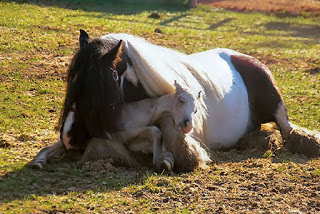
Pony Skin Foals


While I was in Florida, I received this letter from one of my readers:

“My name is Elle, and I absolutely loved your book, the Outside of a Horse! I was wondering if you could let me know where you obtained the statistics in your Author's Note? The statistics about the number of foals born annually (and being killed to avoid the stud fee), and the deaths per every 1,000 starts are the stats I am specifically interested in. I am writing a paper on how to improve the horse racing industry, and I would like to include the appalling statistics of cruelty to help persuade readers. Thanks so much!”


The statistic—about foals being killed to avoid a stud fee—came from a very well-known, downright famous writer friend of mine. Her sister worked in the racing industry and told her about “standing foal,” the practice of deeming a newborn foal unsuitable, by racing standards, and killing it before it stands, thus avoiding the stud fee. I found my notes from that interview, but deemed them too “word of mouth” since I couldn’t re-locate the online site I used to confirm the practice. Lucky me (and you), I came across another, just as despicable.
Using a nurse mare is a common practice in the thoroughbred industry, partly because horse racing rules dictate that mares have to be bred by live cover. (Not artificially inseminated.) This has created an industry of nurse mare farms that breed mares, and replace their newborn foals with expensive, thoroughbred foals to nurse. This frees the thoroughbred mare to be shipped for re-breeding or, if she’s racing, right back to the track.

What happens to the nurse mare’s foal? They are left to die, shot or clubbed to death, or fattened up, and at age six months, can legally be sent to slaughter. (There are YouTube videos of this, if you can stomach watching.) The meat of young horses is prized in many countries, such as Japan. (Tempted to cast stones; we eat veal.)
   
This is just one of the rescue groups dedicated to saving as many of these ‘by-product” foals as they can.  http://www.mountainviewrescue.com/NMF.htm

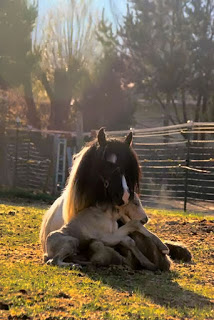
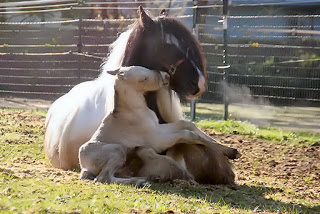
A pony skin foal is another name for a nurse mare foal born so a mare can provide milk to a thoroughbred foal born for racing, or for show. The nurse mare industry is huge, but I couldn't find any statistics on how many foals are produced, and killed annually. A lucky few are rescued, some are sold at auction, others are killed on the spot with a bullet or a club. Whether they end up on a dinner plate in Japan, as dog food, or are killed and skinned for high-end leather products, the nurse mare industry is a disgrace.

And here’s a site with more info on nurse mares


www.shopstyle.com/browse?fts=pony+skin+shoesCached
You +1'd this publicly. Undo
Pony skin shoes at ShopStyle. Shop popular brands and stores to find pony skin shoes on sale - all in one place. Create and share looks based on all your ...  


And are you proud of your genuine shell Cordovan leather couch, or in your car? Most leathers come from cows, but Cordovan comes from horses. It improves with wear and polishing, and is tough as a horse’s butt.
Do you take the Premarin brand of hormone replacement? Pregnant Mare Urine. The fate is the same for their foals, unless a filly is born. She might be permitted to live and follow her mother into the "pee line" where the hormone rich urine is collected during the last six months of pregnancy. Six months tied in a stall, standing in your own feces, with a bag and hose attached to your ureatha.

http://www.youtube.com/watch?v=2I-WYOIx7Ug
http://www.savinghorsesinc.com/PMU_Nurse_Mare_Foal_Rescue.php
And for Elle's paper, here is the site that tracks racetracks deaths. http://www.horsedeathwatch.com/