Non-Human Persons. Cheers for India!

 Animal Minds
 A thought-provoking TED talk.

In a policy statement released Friday, the ministry advised state
governments to reject any proposal to establish a dolphinarium “by any person /
persons, organizations, government agencies, private or public enterprises that
involves import, capture of cetacean species to establish for commercial
entertainment, private or public exhibition and interaction purposes
whatsoever.”
To the Baby in Front of Me by Jessica Kotnour

FYI. Two years ago Jessica won one of the 5 Under 25 scholarships to the Mendocino Coast Writers Conference. Here is a good example of why.
To the Baby in Front of Me
You don’t know me. I don’t know you. Our paths seem to have
crossed. You’re in the seat in front of
me, on a flight from Columbus to Orlando. I’m sure you’re going to Disney.
Or maybe to visit your grandparents. You
are in your mother’s arms. You are
laughing, even if you were crying, it would be okay. You are in a flying tube. You are allowed to cry.
You’re standing up now on your
mother’s legs. Stand there as long as
you can. Let her be your rock. Your foundation. Grip your tiny toes into her quads. Dig deep.
Leave marks.
You keep looking around.
Observing. I wish the top of the plane
were glass so that you could see all of the clouds. They’re so much prettier when you are in them
than they are from the ground. Well,
they are still pretty from the ground as well.
Your sister keeps peaking her
head back and smiling at me. She’s
reading a book. I hope that she never
stops reading. If she ever needs a book,
you call me and I’ll make sure you get one.
Your sister just handed your dad
a sticker. What a special gift. I pray that he saves it. Sticks in on the car window. Sticks it on his phone. Sticks it on his heart.
You are so very young, too young
to be forming memories. By the time you’re my age, you’ll
have formed so many memories, but you’ll have even more to form. Some of them will be good. Some will make you cry. Most of them will involve your favorite
people, maybe your parents, or your friend, or your first dog. I want to tell
you to form memories of every moment.
But you can’t. I am sorry about
that. Try to remember the small
things. The way your mom’s legs feel
underneath your feet right now. The way
your sister gives the most meaningful gifts, like stickers. If you have a dog, remember the
way it feels when he falls asleep on your feet. Hug him often. Hug everyone often.
When you get older, scary things
might start to happen. Tumors will be
found in your best friend’s leg. You
won’t be able to shower because the floor has MRSA. You will be so scared, but you will never be
alone.
I’m on this flight now, heading
back from college. Heading back
home. Back to my mother’s legs. I’ll lay on the couch with her tonight and my
unshaven legs and hers will be next to each other, with the dog laying on both
of our feet.
You are crying now. I am crying now.
Your sister keeps smiling at
me. And I keep smiling back. She’s missing some teeth. She is not fully formed, but neither am I. Neither is anyone.
The flight attendant is coming
through now. We are about to land. I hope that you enjoyed your flight, but if
it was scary and stressful, that is okay. No one expects you to be able to
handle everything.
For now, all we are asked to do
is to stand on our mother’s legs and take it all in.
Can you guess what this is?
| nationalgeographic.com |
News cast from South Carolina
The first time I saw a raft like this was after drenching rains in Texas. I was so astonished when I realized what it was that I nipped the image to create a scene in Lost in the River of Grass. Readers, do you remember where it is?
| oilpalmbiodiversity.com |
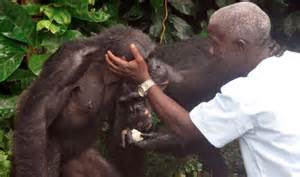
Chimps Face Abandonment
I quietly posted this last week because there was no way to help. Now there is.
How we can Help
 |
| AP Photo |
Uncle Charlie
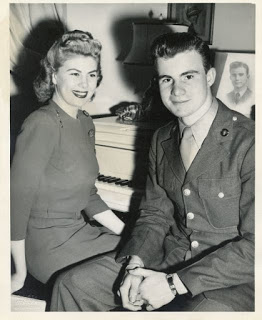 |
| Charlie and my birth mother, Ruth |
If it hadn't been for Charlie's kind and generous heart, I probably would never have met any of them: My mother, my sister, her five sons, my cousins--all of whom I resemble. In his honor, here is that story:
AWAY GROWING OLD
September
1995
I have been away growing old is a line from a poem by Dave
Smith, an acquaintance of mine. It is what I would like to tell my mother, if I
meet her.
I've created an
image of her fifty years ago, a young girl, pressing my tiny hand to her lips, then
passing me to a stranger who took me away to be raised by other strangers. I'd like to reassure her that there was no right or wrong in the
act. I know only what was revealed to me on the course my life took from that
moment on. I do not believe in greener grass, just as I don’t believe that
each choice made has a black and white side, is right or wrong. To have kept me
would have been right if she could have; to give me up was just as correct a
choice. Only when the choices are nearly equally impossible to make, do we feel
the one we made must have been wrong. She
should not grieve.
Three years
ago, after twenty-five years of searching to my own dead ends, I enlisted the aid of an
organization that specializes in putting adoptees and their biological parents
in touch with each other. A few months later they called to tell me that my father
was dead but they had found my mother, did I want to call her or should
they? I chose for them to call. She was sorry, they said, but she couldn’t see me. Since then, I have wished I had chosen to
call myself. Would she have said no to me?
Last week, Jack,
an attorney friend of my husband’s was going to the town where she lives. My
husband, whose choices rarely confuse him, had him call her. A man answered. Jack
told him who he was and that he was just calling to ask a few questions.
The man said he was my mother’s brother, could he help in some way? Jack said no,
it was a private matter.
I do believe
we are sometimes given second chances.
“Is this
about her other daughter?” my mother’s brother asked.
"You know about her?" Jack asked.
"I'm the only one who does."
My uncle went on to say how happy he was Jack called. He was visiting because my mother had open-heart surgery and was recovering at my (half) sister’s house.
"You know about her?" Jack asked.
"I'm the only one who does."
My uncle went on to say how happy he was Jack called. He was visiting because my mother had open-heart surgery and was recovering at my (half) sister’s house.
I have a
good friend who believes what ails us is an outward manifestation of where our
grief and pain is. A sore throat comes from a voice we stifle; a stomach ache
from grief we swallow. I think, if my friend is right, there may now be room for me in my mother’s heart.
My uncle
will be home from the visit with my mother the first of August. He wants to
know me. He said, “Tell her she has an Uncle Charlie who wants to meet her.”
So now, a half century later, it works out that on my 51st
birthday, I will see the first blood relative I have ever known. Someone who
may say to me, “Why you look just like . . .” And I’m
hoping that between Uncle Charlie and open-heart surgery, my mother will accept
this message: I’ve been away growing old and in all that time, I have learned
all about pain and joy and losses and rewards. I believe that the same door
that opened for her two year ago is open again, and beyond it—through it—is
simply her other daughter.
Charles Grether
October 19, 1926 - July 3, 2015
I'm going hog wild . . .
No posts for 6 months, now you can't shut me up.
Does ‘Jurassic World’ remind you of ‘Blackfish’? How a dinosaur movie tackled animal rights. By Emily Yahr
This article compares the treatment of these dinosaurs to the treatment of captive Orcas.
Think about it!
This isn't my Public Shtick, but...
I grew up in central Florida in the 50s and 60s, and God love 'em, my parents were racists. They hated JFK, MLK, and LBJ. They adored Lucinda, our black housekeeper for nearly two decades. Daddy called crying when she died.
The article that motivated me to write this out-of-purview post is below. It coupled with the outlandish, offensive, bigoted statement about Mexicans by "The Donald" --a national embarrassment and Republican presidential candidate, makes it impossible for me to stay quiet. Besides, I've been there, done that.
It didn't take a college education or a graduate degree for me to recognize how wrong my parents were. It took a 1963 bus ride. My moment of insight is on my website:
A Vote for Lucinda --if you're interested.
Some of you may be thinking I should just stick to my little animal stories, but the belief that we have the God-given right to lord our superiority over even the smallest, most defenseless of other species is what I write about. It stems from exactly the same mind(less) set as racism. It's called speciesism--the belief that the human race is superior to other species, and that exploitation of animals for the advantage of humans is justified. Encarta ® World English Dictionary ©
I think following article is important to consider. I hope you feel the same. And to my readers in Europe, Asia, South America, and especially in Mexico, we won't actually elect The Donald, or Ted Cruz. I'm almost positive.
*
Anti-intellectualism Is Killing America | Psychology Today
"In considering the senseless loss of nine lives in Charleston, of
course racism jumps out as the main issue. But isn’t ignorance at the
root of racism? And it’s true that the bloodshed is a reflection
of America's violent, gun-crazed culture, but it is only our aversion to
reason as a society that has allowed violence to define the culture.
Rational public policy, including policies that allow reasonable
restraints on gun access, simply isn't possible without an informed,
engaged, and rationally thinking public."
For the entire article...
If Corporations are People . . .
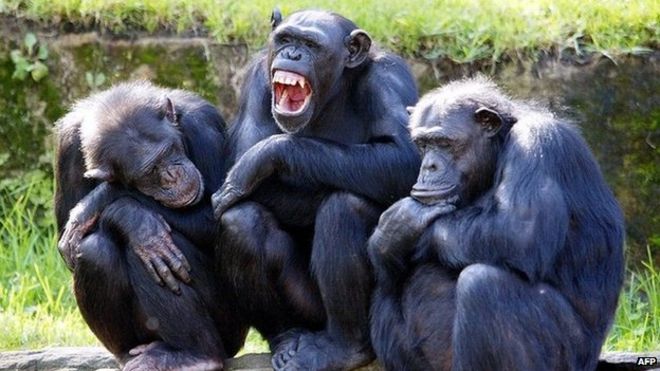
A
judge in New York has issued a writ of habeas corpus in a case brought
by animal rights activists on behalf of two chimpanzees.
Personhood could end this.
I haven't done a post in six months. It's certainly not because I had nothing to say or there weren't animal abuses going on, or good news to report. I've been working on a couple of projects. One, of course, is How to Speak Dolphin, my new novel about an non-verbal autistic child and a captive dolphin. It's out now and available in bookstores--especially your local independent bookstore.
I guess this post is part ad for HTSD, so I might as well add that the e-book version of Dolphin Sky, which I rewrote a year or so ago, is on sale through Kobo, Nook, Kindle, and iBook.
My other excuse: I've been researching my first attempt at writing historical fiction. When I returned from a research trip to Texas, Cory, my 16 year old cat, was blind. She coped far better than I did, but every moment of the rest of her life became precious. She spent the next seven months on a pillow in a desk drawer at my elbow as I wrote. She died May 21st. I suppose her decline and loss has made it hard for me to feel strongly about anything else.
I have a new favorite quote. From MC Davis
"I can't change people your age," he says, "but give me a fourth-grader."
Happy Holidays to all
Happy Animal Club update
I received the news yesterday that Ken, founder of the Happy Animals Club (see last week's post), has been awarded a $1000 grant from The Pollination Project. This is the first time, in the three and a half years I've been blogging, that I've been made aware of a domino falling. My tail's wagging.

Giving Seed Grants to Social Change Projects
We provide $1,000 startup grants to individual change makers and projects that promote compassion around the world.
Watch the CBS This Morning segment on the Pollination Project
Seed money sprouts change for tiny non-profits - CBS News
www.cbsnews.com/.../seed-money-sprouts-change-for-tiny-no...
Mar 23, 2014 - Seed money sprouts change for tiny non-profits ... He gave away his 447th grant this morning -- that's $447,000 and counting. In the past ...
CBS News
Happy Animals Club
Happy Animals Club is a non-profit no-kill animal shelter project in the southern Philippines, started by a 9-year-old
boy with help from international donors. Imagine, if one child can accomplish this in the Philippines...


Bring a Sandwich. Maybe not Tuna
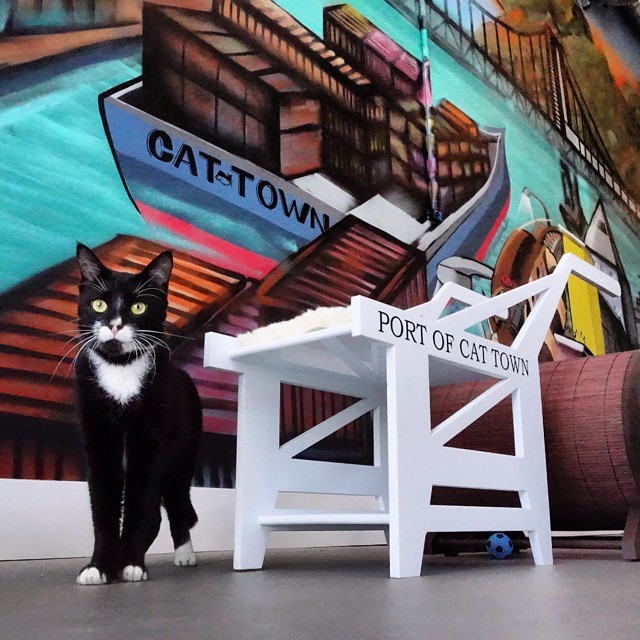
The Cat Town Cafe is split into two rooms. ". . .the Cafe is minimal, but awesome."
They serve coffee, locally made bagels and pastries, with limited indoor and outdoor seating, plus viewing windows into the Cat Zone should they reach capacity.
The Cat Zone is where you are welcome to bring food and a beverage.
- We have between 6 - 20 free roaming cats who are available for adoption. Since founding, we’ve helped get over 600 at-risk shelter cats out of the cages of Oakland Animal Services and into loving foster and permanent homes.
- We allow 14 people to enter every hour on the hour, this is to help limit the stress and over stimulation of our four legged friends.
- Walk-ins are welcome, but we highly recommend that you make a Cat Zone Reservation for a $10 donation to Cat Town, especially on weekends! This will ensure your visiting time is available and support a great cause.
I fell in love hook, line, and sinker.
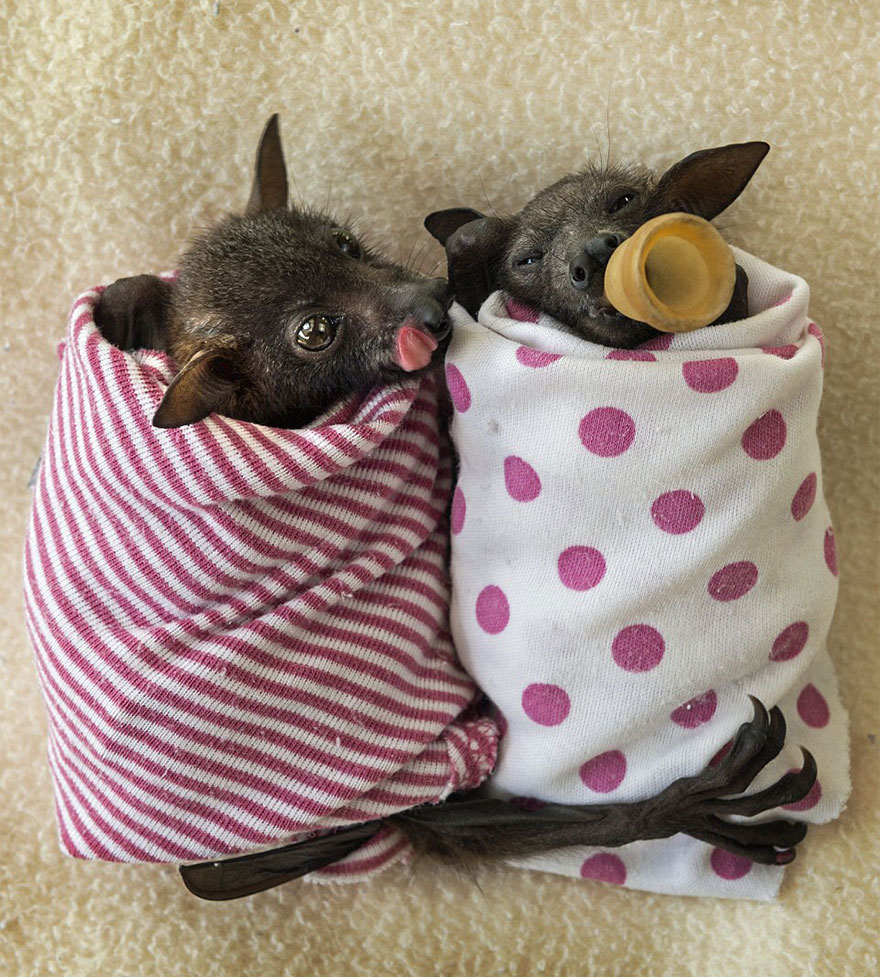 Some of you may recall that I had a bat in my bathroom for seven summers. Last year, Johnnie failed to reappear. I'm optimistic that he just reached an age when looking for female companionship was far more interesting than buzzing me on his way to the bathroom.
 A friend sent this link to me this morning. I'm totally smitten. The pictures are melt-your-heart great.
Black Cat audition circa 1961

Thinking Outside the (nest) Box
| Marbled Murrelet odysseykayaking.com |
Portia Halbert, of Humboldt State University, was thinking outside the (nest) box when she came up with a unique idea to save the endangered Marbled murrelet, a small seabird that feeds at sea and nests only in old growth forests.
Stellar jays and Ravens eat murrelet eggs, so giving them a reason to never eat another was her clever idea. So far so good, but outsmarting a Jay can be tricky. Read the full story: Dietary Lessons
 
| ||
| Marbled Murrelet conservation |
Upgrading the cells at San Quentin
 | |
| Lolita at the Miami Seaquarium |
 By Tom Gara
 "SeaWorld Entertainment Inc. (SEAS), suffering from negative publicity and flagging attendance, plans to announce on Friday a new expansion of the habitats housing its signature killer whales."
First let's define the word habitat, because saying you are going to upgrade a captive marine mammal's habitat sounds upbeat, doesn't it? Like adding wallpaper to a prisoner's cell at San Quentin or Sing Sing, and putting in a porcelain toilet with a heated seat.
Encarta ® World English Dictionary © defines habitat as:
1. ecology home environment: the natural conditions and environment in which a plant or animal lives, e.g. forest, desert, wetlands, OR OCEAN.
2. typical location: the place in which a person or group is usually found -- OR OCEAN.
3. artificially created environment: a sealed controlled environment in which people OR CAPTIVE ANIMALS can live OR BE KEPT ALIVE in unusual conditions such as under the sea or in space. OR IN A CONCRETE TANK.
"The company is locked in a battle with animal-rights activists, who say that training and publicly performing killer whales is an inherently cruel act. The documentary "Blackfish," which has been screened in cinemas and broadcast multiple times by CNN, raised these criticisms to a higher level of public awareness, and has harmed the company's financial results."
So SeaWorld's solution: Add 15 feet of depth to their pool and 5 million more gallons of water. Happy Whales. And their real motivation? "Investors haven't been kind. SeaWorld shares fell by one-third on Wednesday and are off nearly 50% over the past 12 months. The stock declined another 4.8% to $18 on Thursday."
 We can still fix this by not going to SeaWorld or the Miami Seaquarium, now or ever.
  |
| Lolita is 21 feet long in a tank that is 23 feet deep. She shares this space with 3 Pacific White-sided dolphins. It has been her habitat for 44 years. |
The Tale of a Nose by Sallie Reynolds
 |
| Charcoal by Sallie Reynolds |
The Tale of a Nose by Sallie Reynolds
Ginny loves Turkey Vultures as much as I do. But most of you probably don't often think about them, any more than you think about garbage collectors. Silently, these birds perform a similar great service. Many more animals die than can be consumed quickly by predators, scavenging mammals, insects, and microbes. So it's avian sanitary engineers to the rescue: From the air, they find carcasses more quickly and can get to them speedily. And since the sight of descending vultures is like a dinner bell, a carcass is often picked clean by a large crew, within hours.
You can Google “New World Vultures” and find the basics of
their lives (try my website: www.takethemoment.org/species
for a detailed introduction). But here are a few esoteric bits:
The story of our Turkey Vulture, or TUVU – one of the two
vultures we have in California – is the tale of a nose. TUVUs are different
from other vultures. They have a keen sense of smell, much keener than the
famous nose of bloodhounds, much much keener than the noses of all other
vultures (except two cousins in South America). Miles away and high overhead,
they sniff out all newly dead creatures. Hawks, eagles, and other diurnal
hunters find their prey by sharp eyesight; owls, being nocturnal, find theirs
largely by hearing. TUVU uses his nose. It's not that other birds can't smell –
we're discovering that that old wives tale is false. But TUVU's nose rules and
he is the first to the party. Good thing, too, because, unlike hawks and owls,
TUVUs can't kill with their wimpy feet, and their beaks are not very powerful
either. This may be one reason they hang around roads: cars carve up the dinner
beast before they get there, so they can eat fast before the rough, tough
coyotes arrive and drive them away.
 |
| The adult w/ red head, shows the incredible nostril of this smelling machine |
Vultures not only clean up dead animals, they
reduce contaminants in the soil around their dining room. Their super-acid digestive juices (truly odoriferous!) kill many serious pathogens, including those causing salmonella
poisoning, rabies, and anthrax. The indigestible bits from their meal are then
compacted by the gizzard into a large pellet. This they regurgitate, a little
present for microbes (microbes have the last word on us all). And since bird
poop is mostly liquid and their intestines don't store wastes, the slurry is
eliminated as it is produced. Vultures squirt it onto their own legs,
apparently as a cooling mechanism, but it also sprays generously onto the
ground, a tidy if stinky solution to potentially dangerous problem.
Whew! Did I say “keen noses?” Well, yes; even though they
love smells we hate, they are, in own their way, quite discriminating. A few
years ago, a captive TUVU developed a strong attachment to one of his keepers.
He'd approach the fence when the man appeared and behave in a friendly manner.
Then the man died. Two years later, his wife visited the compound and
approached the TUVU's cage. The bird made a bee-line for her, displaying all
the signs of recognition and affection he had shown toward his friend. Turns
out she was wearing her dead husband's jacket.
This extraordinary nose lets the TUVU perform another little
service: Before piping gas from a well to a storage tank, gas companies perfume
the odorless natural product with ethyl mercaptan, the chemical produced by
decomposing bodies. When a pipe springs a leak, TUVUs quickly gather overhead.
Company crews can then find the leak and repair the pipe.
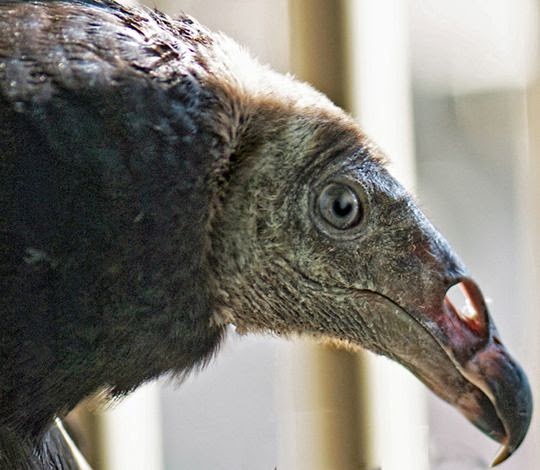 |
| Fledgling with gray head and blue eye. |
What would happen if these birds disappeared? In the last 20
years, India and Pakistan have seen their billions of vultures dwindle to a few
thousand, poisoned by a cheap non-steroidal anti-inflammatory drug given to
cattle raised for leather and dog-food exports. For millennia, the birds had
kept down filth and pathogens, even in large over-crowded cities. But today,
garbage areas have become stinking sumps and rabies is spreading from the
mammalian scavengers to humans.
Fortunately this is in no danger of happening here. In the
US today our vultures are thriving: TUVUs are common and increasing. The
smaller, scrappier Black Vulture, found in the East and South, is moving into
new territories. And the California Condor, after a truly dramatic recovery
process, is coming back from the very brink of extinction.
 The line drawing is of a
single vulture, from a photo of a wall painting in Catal Huyuk, Turkey, from
about 8000 years ago.
The line drawing is of a
single vulture, from a photo of a wall painting in Catal Huyuk, Turkey, from
about 8000 years ago.
The Miami Animal Shelter by Melissa Rey
| critterbaby.com |
Melissa and I have
been email buddies for a couple years now. She'll be a junior in high school
and is a straight A student. (No surprise.) When she wrote me yesterday about
these kittens, I was reminded of my own experiences with the Miami Animal
Shelter—still a contradiction in terms.
I wish Melissa’s
story was a rare one, but mostly I wish she had met someone with a heart, who
saw a kid trying to do what irresponsible adults failed to do, and I wish that
woman had kept her big, stupid mouth shut. A pox on her and the people who
dumped the kittens.
Melissa took the same
route I did 35 years ago. She wrote about it. I have changed nothing in her
story except to spell out the numeral 15.
My
Experience with the Animal Shelter in Miami
Melissa
Rey
There are moments in my life in which I am able to look
at the world and have some faith in humanity. Yesterday, however, was not one
of those moments. It was one of those days in which you witness such tragedy,
that you no longer know what to think about society. It was approximately 3:00 in the afternoon in Miami, Florida, in an
area that is rather polluted and very, very hot. It was about 95 degrees
outside and the humidity made me feel as though I were in a sauna.
I had an appointment in this area and as I prepared to
get inside of my car after my appointment, I heard high-pitched meowing.
Curious, I stepped out of my car and on the side of the road I found 3 kittens
that had been placed in a black crate with a dirty cloth, some garbage, and a
combination of rice and soil. The kittens were attempting to get out of the
crate in an effort to find some shade, but they lacked the strength to get out.
Their eyes were a beautiful clear blue, and I estimated they were about 2 weeks
old. I could tell they had been deliberately left there as there is no way
2-week-old kittens can get into the crate by themselves and there is absolutely
no way a mother cat will leave her babies. I was struck by the mental image of
those little ones being cruelly ripped away from their mother and watched them
as they huddled together seeking comfort.
I now had two choices: I could leave
the kittens alone so that they could die a lonely, torturous death where they
would most likely starve, dehydrate, and bake under the hot sun or I could
“rescue” them and take them to the shelter. I went on to pick up the kittens
and sat in the backseat of the car with the kittens on my lap. On the 15 minute
trip to the shelter, the kittens were so thirsty that they desperately licked
the moisture on my arms. It was one of the most heartbreaking things I had seen
in my whole life. They quieted as I held them in my arms and stroked their
fluffy fur.
Fifteen minutes later, at
approximately 3:30, we
arrived at the “shelter.” I was not impressed by the exterior. Quite frankly,
the exterior of this “shelter” looked more like a death camp or prison. It was
dirty, loud, and the employees were harsh and unhelpful. I was directed to this
cat drop off area that was surprisingly clean. To the right of the wall were a
series of cages that housed a variety of stray cats that had been rescued and
were being put up for adoption. There were some people there in the process of
adopting cats. For a brief moment, I was content because I thought these little
ones would be put into a loving home. However, I was wrong. I was very wrong.
When I walked in with the kittens,
this young woman approached me telling me she was an employee. As soon as I saw
this woman, my hopes began to go down. She had a very negative personality and
her face told me that not only did she not want to be working there, but she
did not care at all for those cats. I told her how I had found the kittens and
after hearing my story, she told me to take them back to where I had found
them. I looked at her with a combination of shock and disgust. I told her, “I
can’t. They’re going to die.”
She looks at me and she says,
“They’re too young. Either you can take them back where you found them or keep
them until they are 1.5 pounds and then bring them back. If you leave them
here, they will be euthanized by tonight.” When she told me that, I felt very
numb. However, I did not have a choice. I live in an apartment where cats are
not allowed and I do not have the money to take care of 3 kittens anyway. Once
again, I was faced with two choices. I could leave them here to die what I hope
was a painless, quick death, or I can take them back and they would die a slow,
torturous, and painful death.
I had no choice but to leave them
here. She pointed to a small cage by the window which was separate from the
rest of the cats. When I attempted to put them in the cage, the kittens clung
on to me and my shirt and I had to physically remove the cloth from their
little claws. I couldn’t bear to watch them all snuggled up in their sad little
cage, so I immediately turned away. This employee then gives me a paper which
was titled “Good Samaritan.” On this paper, I had to put down my information so
that the cats could be “put to sleep.” I had the urge to rip up this paper. At
that moment, I felt like everything but a Good Samaritan. I had just given my
consent so that three babies could be murdered.
I walked quickly out of there, got
into the car, and didn’t look back. My grandparents dropped me off at my house,
and I just walked to my room and laid in bed. The moment I did that I broke
down. I felt like an absolutely horrible person. The disgust and horror at what
I had witnessed left me feeling sick. All I could think
about were those kittens. I imagined their terror and discomfort at being put
in a cold metal cage. I didn’t even want to begin to imagine how they had been
euthanized or how their little bodies had been dumped into the garbage as if
they were worthless trash.
This is not just an issue in Miami.
This is a nationwide crisis. This “shelter” does not have the right to be
called that. It is a prison for the innocent and defenseless. This “shelter” is
a death camp. My experience is not unique at all. This happens to thousands and
thousands of poor, defenseless animals every year. If we do not have any
respect and love for these defenseless creatures, how can we expect respect and
love amongst our own selves?
IMMEDIATELY AFTER THIS WAS POSTED, I GOT A CALL FROM A FRIEND IN MIAMI. THIS IS THE NUMBER OF THE CAT NETWORK. 1.305.255.3482.
IMMEDIATELY AFTER THIS WAS POSTED, I GOT A CALL FROM A FRIEND IN MIAMI. THIS IS THE NUMBER OF THE CAT NETWORK. 1.305.255.3482.
Blog Slug
 |
| Slime Mold |
 |
| Banana Slug |
I did want to share this interview with you. Kellee Moye is a middle school teacher in Florida. She's been teaching Hurt Go Happy in her classes since it came out in 2006. She's not a slug. She reads more books than seems humanly possible, especially as a new Mom, and I'm eternally grateful to her for supporting my writing endeavors. This year is the 10th anniversary of the Schneider Family Book Award which Hurt Go Happy won in 2008. Kellee interviewed me for the anniversary. Unleashing Readers